


Every founder asks the same question sooner or later: “What should my performance marketing budget be? Set your performance marketing budget too low, and you never collect enough data to learn anything. Set it too high, and you burn through your runway before you find a message that works.
At Tarun Marketing, we have worked with startups at every stage, and we have seen both mistakes many times. This guide explains how to plan your performance marketing budget for the first six months, how to split it across channels, and how to tell whether it is working. By the end, every rupee you spend will have a clear job.
What Is a Performance Marketing Budget?
A performance marketing budget is the money you set aside for paid channels where you pay only for measurable results, such as clicks, leads, sign-ups, or sales. Google Ads, Meta Ads, LinkedIn Ads, YouTube Ads, and affiliate programs all fall into this category.
For a startup, the performance marketing budget matters far more than it does for an established brand. You have no historical data, no loyal audience, and no big brand name to lean on. Every customer must be won through testing. At Tarun Marketing, we treat the first six months as a learning phase, and your performance marketing budget as the price of learning what works.
How Much Should Your Performance Marketing Budget Be?
There is no universal number, but these benchmarks give you a solid starting point:
- Percentage of revenue target: Many startups allocate 10% to 20% of projected revenue to marketing, and a large share of that goes to performance channels.
- Percentage of funding: If you have raised money, 15% to 25% of your marketing runway is a common range for your performance marketing budget.
- Monthly range in India: Most early-stage startups begin between ₹30,000 and ₹1,50,000 per month, depending on their industry and order value.
Tarun Marketing usually advises founders to avoid a performance marketing budget below ₹30,000 per month. Below that level, the data is too thin to draw reliable conclusions, especially in competitive categories like education, finance, or real estate, where a single click can cost ₹50 to ₹150.
5 Factors That Decide Your Performance Marketing Budget
Before you fix a number, look at these five variables.
1. Industry and cost per click. Clicks in finance, education, and real estate cost far more than clicks in a niche D2C category. Research your average CPC before you finalize your performance marketing budget, because it decides how many clicks, and therefore how much learning, each rupee buys.
2. Average order value and lifetime value. If a customer is worth ₹10,000 to you, you can afford to pay much more to acquire them than if they are worth ₹500. Higher customer value means a more flexible performance marketing budget.
3. Target customer acquisition cost (CAC). A healthy rule of thumb is for lifetime value to be at least three times your CAC. Work backward from this ratio to size your performance marketing budget realistically.
4. Sales cycle. B2B startups with long sales cycles need more patience and a larger performance marketing budget than fast-moving e-commerce brands, because results take longer to show up.
5. Runway. Never plan a spend that leaves you with less than six months of operating cash. Your performance marketing budget should accelerate growth, not threaten survival.
Month-by-Month Performance Marketing Budget Plan
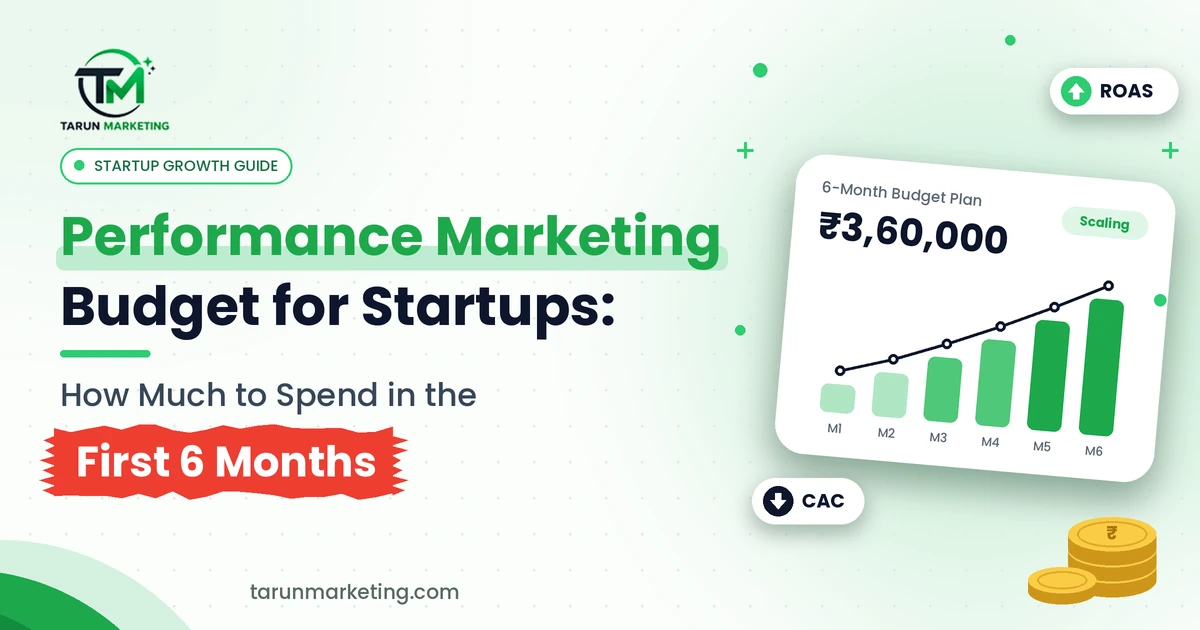
Here is the framework Tarun Marketing uses, based on a sample total of ₹3,60,000 over six months (about ₹60,000 per month on average). Adjust the numbers to fit your own situation.
Month 1: Setup and Testing (10%, about ₹36,000)
Start small. In month one, your performance marketing budget is for testing audiences, creatives, and offers, not for generating big sales. Set up tracking (Google Analytics 4, Meta Pixel, conversion events) before spending anything. Broken tracking is the most expensive mistake a startup can make, because you end up paying for data you cannot use.
Month 2: Learning and Refining (12%, about ₹43,000)
Review what month one taught you. Which audiences clicked? Which creatives held attention? Pause the losers, back the winners, and test only one new variable at a time, such as a headline, an image, or a landing page.
Month 3: Finding Your First Winners (17%, about ₹61,000)
You should now have two or three ad sets or keywords converting at an acceptable cost. Raise your performance marketing budget on these by no more than 20% to 30% at a time, so the platform’s algorithm does not reset its learning.
Month 4: Optimization (20%, about ₹72,000)
Shift from experimenting to improving efficiency. Work on landing page conversion, launch retargeting campaigns, and build lookalike audiences from your early customers. Tarun Marketing clients often see their biggest cost improvements in this phase.
Month 5: Controlled Scaling (20%, about ₹72,000)
If your ROAS and CAC are healthy, this is the time to scale. Add a second channel, for example Google Search alongside Meta, but only when the first channel is stable and predictable.
Also Read -Digital Marketing Metrics Explained: CPC, CTR, CPA, ROAS and What They Mean
Month 6: Scale and Review (21%, about ₹76,000)
Push harder on what works, then run a full review. Compare your actual CAC, ROAS, and payback period against your original goals, and use the results to plan your next performance marketing budget with real data instead of assumptions.
How to Split Your Performance Marketing Budget Across Channels
A common starting split looks like this:
- 70% on one primary channel: Google Search for high-intent products, Meta for visual or impulse-driven products.
- 20% on a secondary channel: Retargeting, YouTube, or LinkedIn for B2B.
- 10% on experiments: New platforms, new formats, or new audiences.
Resist the urge to be everywhere at once. The Tarun Marketing rule is simple: master one channel before you add another. A focused performance marketing budget always beats one spread thinly across five platforms.
Rules for Managing Your Performance Marketing Budget
Use the 70/30 rule. Put about 70% of your performance marketing budget into what already works and 30% into testing new ideas. In the first two months, flip this ratio, because nothing is proven yet.
Set a stop-loss. Decide in advance the maximum CAC you will tolerate. If a campaign exceeds it for two weeks with no improvement, pause it and reallocate the money.
Give campaigns time. Judging an ad after two days leads to bad decisions. Most platforms need 7 to 14 days and around 50 conversions to optimize properly.
Track the right numbers. Focus on CAC, ROAS, conversion rate, and payback period. Impressions and likes look good in reports, but they do not pay salaries.
Keep a 10% buffer. Hold back a small reserve so you can double down quickly when a campaign suddenly performs well.
Common Performance Marketing Budget Mistakes
- Starting too big. A large performance marketing budget behind an unvalidated offer just wastes money faster.
- Starting too small. A tiny budget never exits the learning phase and teaches you almost nothing.
- Ignoring the landing page. Great ads cannot fix a slow, confusing page. Improve conversion before you increase spend.
- Chasing too many channels. Five platforms on a small budget leaves each one underfunded.
- Weak tracking. If you cannot see which ad led to which sale, you are guessing, not optimizing.
- Expecting profit in month one. Early on, your performance marketing budget is buying information. Profitability usually follows once you know what works.
How to Know Your Performance Marketing Budget Is Working
After six months, ask yourself these questions:
- Is my CAC lower than it was in month one?
- Is my ROAS rising, or at least stable?
- Do I know my best audience, offer, and creative?
- Can I predict what an extra ₹10,000 of spend will return?
If most answers are yes, your performance marketing budget did its job, even if you have not yet hit your revenue target. You now own something valuable: a repeatable, data-backed customer acquisition system that you can scale with confidence.
Should You Run Campaigns Yourself or Hire an Agency?
Running campaigns yourself in the first month or two can be a great way to learn. But as spending grows, small mistakes become expensive, and a poorly managed performance marketing budget can drain your runway quickly. Tarun Marketing helps startups build proper tracking, run structured tests, and scale only what the data supports, so your money goes toward growth rather than guesswork.
Final Thoughts
So, how much should a startup spend on performance marketing in its first six months? For most Indian startups, the total performance marketing budget falls between ₹2,00,000 and ₹6,00,000, spread across a phased plan that moves from testing to scaling. The exact figure matters less than the discipline behind it: track everything, test one variable at a time, scale only proven winners, and protect your runway.
If you want a customized performance marketing budget plan for your business, the team at Tarun Marketing is ready to help. Share your goals, industry, and runway, and we will map out a realistic six-month roadmap with you.
