
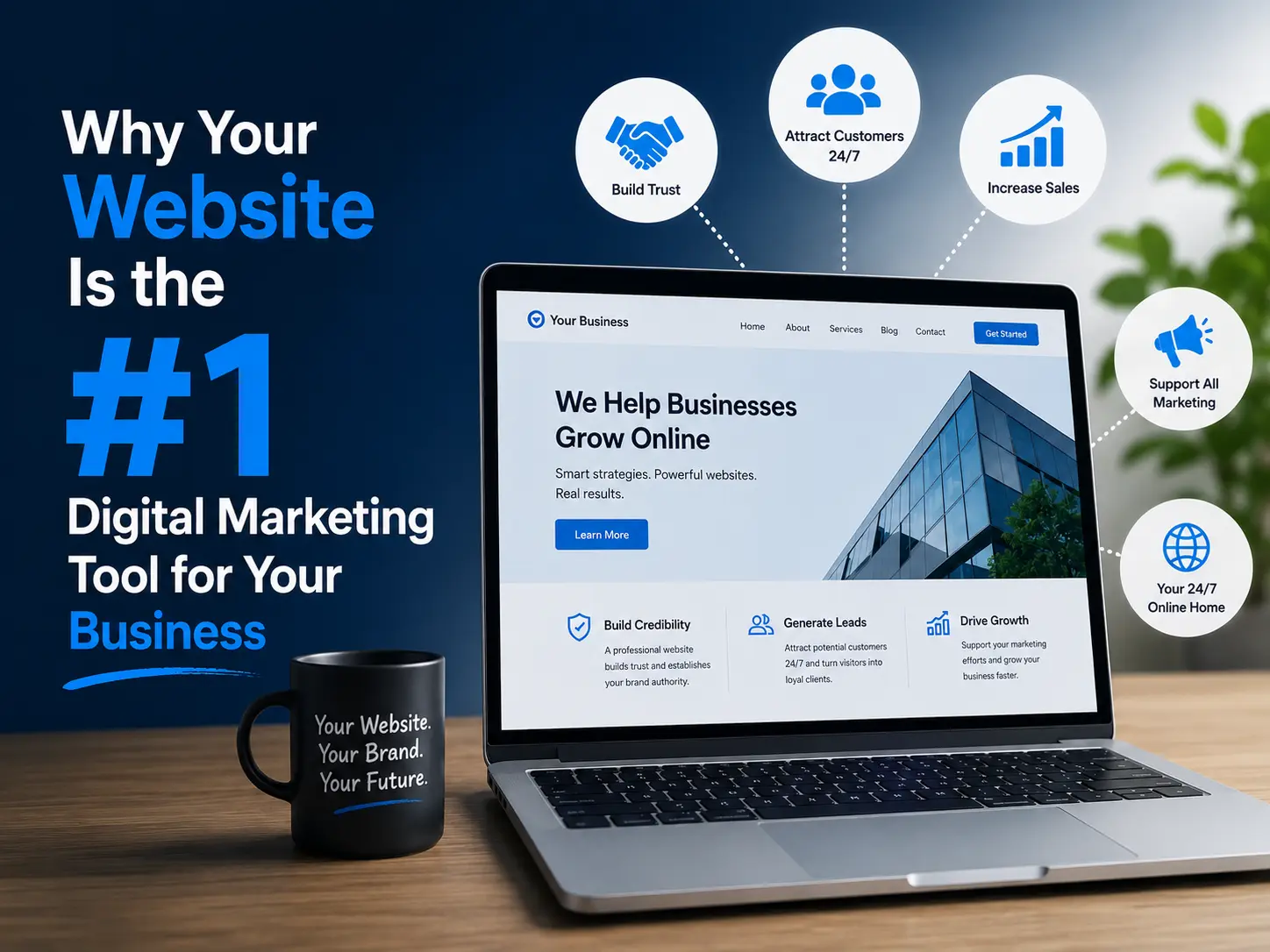
Why Your Website Is the #1 Digital Marketing Tool for Your Business
Introduction
Think about the last time you searched for a service online. What did you do first? You visited their website.
That’s exactly what your potential customers are doing right now. Before they call you, message you, or buy from you — they check your website.
Your website is not just a page on the internet. It is your most powerful digital marketing tool. It works 24/7, reaches thousands of people, and represents your brand every single day.
In this blog, we’ll explain exactly why your website is the #1 digital marketing tool for your business — and what you can do to make it work harder for you.
1. Your Website Works 24/7 — Even When You Don’t
Unlike a salesperson who works 8 hours a day, your website never sleeps. It is always available for your customers — at midnight, on weekends, on holidays.
Someone in another city can visit your website at 2 AM, read about your services, and send you an enquiry — all while you are sleeping.
No other digital marketing tool gives you this kind of round-the-clock visibility.
2. It Is the Center of All Your Digital Marketing
Think of your digital marketing like a wheel. Social media, Google Ads, SEO, email marketing, WhatsApp — these are all the spokes. But your website is the center that holds everything together.
- You run a Facebook Ad → it sends people to your website
- You post on Instagram → you add your website link in bio
- You do SEO → Google shows your website in search results
- You send an email campaign → the link goes to your website
Without a strong website, all your other digital marketing efforts are wasted. Your website is where everything comes together and where conversions happen.
3. It Builds Trust and Credibility Instantly
People judge a business in less than 5 seconds of visiting their website.
A clean, professional website tells your visitors:
- “This business is real and trustworthy”
- “These people know what they are doing”
- “I feel safe buying from them”
On the other hand, a poorly designed or outdated website makes people leave immediately — and go to your competitor.
Your website is your first impression. Make it count.
4. It Helps You Rank on Google (SEO)
SEO — Search Engine Optimisation — is one of the most powerful free marketing strategies available. And it only works if you have a website.
When someone searches “digital marketing agency in my city” or “best web design services,” Google shows them websites. If your website is well-optimised, your business appears at the top of the results.
This means free, organic traffic to your business every single day — without spending money on ads.
A good website = better Google rankings = more customers finding you.
5. It Converts Visitors Into Paying Customers
Social media gets you followers. But your website gets you clients.
A well-designed website has:
- A clear message about what you offer
- Strong call-to-action buttons like “Book a Call” or “Get a Free Quote”
- Testimonials and case studies that build trust
- A simple contact form that makes it easy to reach you
All of these elements work together to turn a random visitor into a paying customer. No other platform gives you this level of control over the customer journey.
6. It Gives You Data and Insights
One of the biggest advantages of a website is data. Tools like Google Analytics show you:
- How many people visited your website
- Which pages they visited
- Where they came from (Google, social media, direct)
- How long they stayed
This data helps you understand your audience better and improve your marketing strategy. You cannot get this level of detail from a social media page.
faq
1. Why is a website important for a business?
A website serves as your online storefront, helping potential customers learn about your products, services, and brand 24/7.
2. How does a website support digital marketing?
Your website acts as the central hub for all digital marketing efforts, including SEO, social media, email marketing, and paid advertising campaigns.
3. Can a business survive without a website in 2026?
While some businesses rely on social media, a website provides greater control, credibility, and long-term growth opportunities that social platforms alone cannot offer.
4. How does a website help generate leads?
A website can collect customer information through contact forms, inquiry forms, chatbots, and downloadable resources, turning visitors into potential customers.
5. What role does SEO play in website success?
SEO helps your website rank higher in search engines, making it easier for potential customers to find your business online.
6. Is a website better than social media for marketing?
Both are important, but a website is owned by your business, while social media platforms can change algorithms and policies at any time.
7. How can a website improve customer trust?
A professional website with testimonials, reviews, certifications, and clear business information helps establish credibility and trust.
8. What features should every business website have?
Essential features include mobile responsiveness, fast loading speed, contact information, clear calls-to-action, service pages, and SEO optimization.
9. What are digital marketing tools?
Digital marketing tools are software platforms and applications that help businesses plan, execute, track, and optimize their online marketing efforts — covering areas like SEO, social media, email, analytics, and advertising.
10. Why do small businesses need digital marketing tools?
Digital marketing tools save time, reduce manual effort, and provide data-driven insights that help small businesses compete with larger companies without needing a huge in-house team.
11. What are the most important types of digital marketing tools?
Key categories include SEO tools (for search rankings), social media management tools (for scheduling and analytics), email marketing platforms, analytics tools (like Google Analytics), and advertising platforms (like Google Ads and Meta Ads Manager).
12. Can digital marketing tools replace a marketing agency?
Tools can automate tasks and provide data, but they can’t replace strategy, creativity, and expertise. Most businesses get the best results by combining the right tools with professional guidance.
13. How do analytics tools help improve marketing performance?
Analytics tools track visitor behavior, conversion rates, and campaign performance, helping you understand what’s working and where to adjust your strategy for better results.
14. What’s the difference between free and paid digital marketing tools?
Free tools often cover basic needs like scheduling or simple analytics, while paid tools typically offer deeper insights, automation, integrations, and scalability as your marketing needs grow.
15. How do I choose the right digital marketing tool for my business?
Consider your specific goals (SEO, social media, email, etc.), budget, ease of use, and whether the tool integrates well with your existing website and systems.
16. Can digital marketing tools help with lead generation?
Yes. Many tools include features like landing page builders, form integrations, chatbots, and CRM syncing that capture and nurture leads automatically.
At TarunMarketing, we design websites that don’t just look good — they generate real business results.
Ready to turn your website into your best salesperson? Contact TarunMarketing today.
