

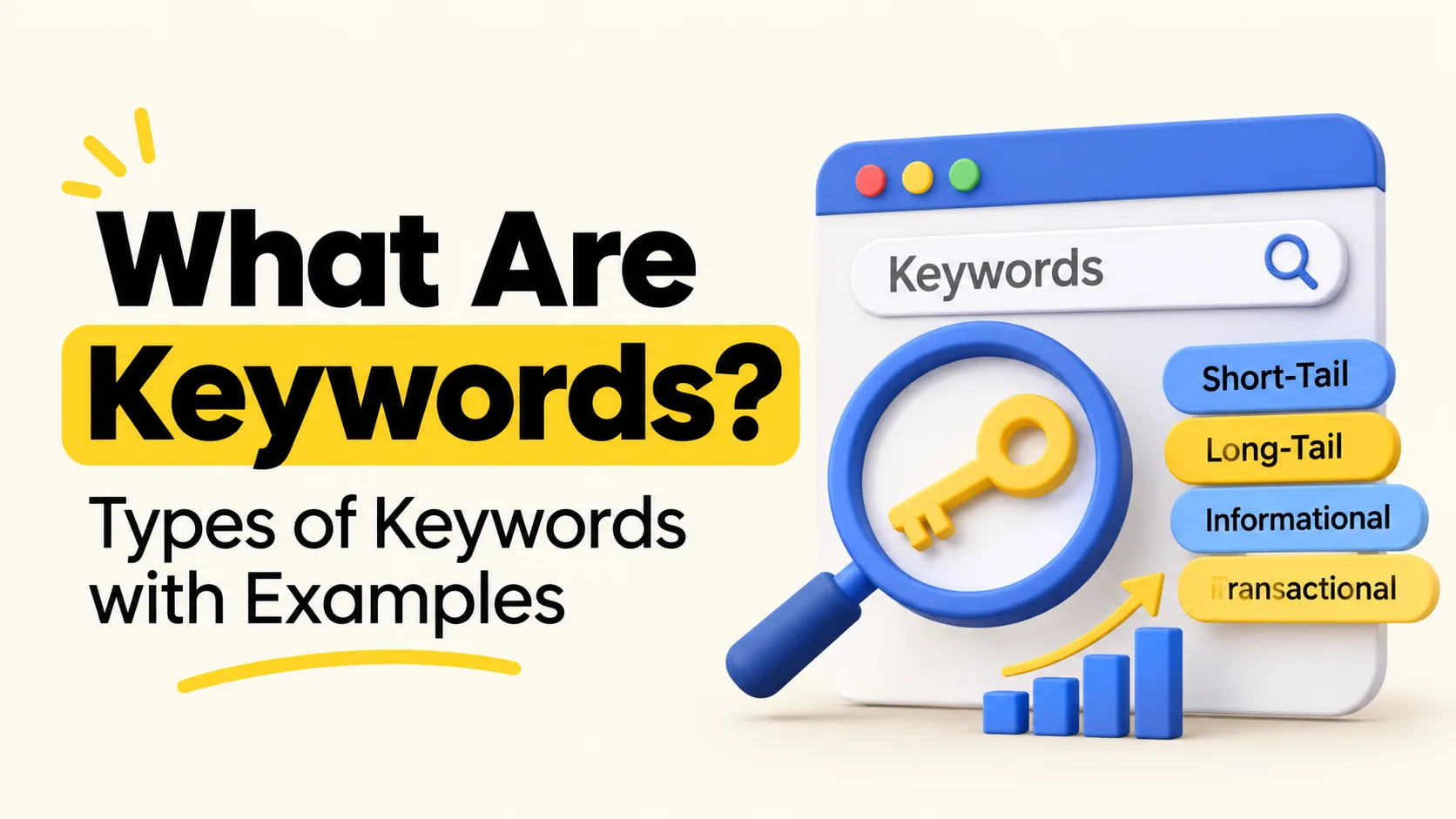
What Are Keywords? Types of Keywords Explained with Examples
Introduction
What do you do when you search for something on Google? You type a few words and press Enter. That’s it.
The words you typed are called keywords.
Now think about it: your potential customers are doing the same thing. Someone types “dentist near me”, and someone else types “best digital marketing agency Jalandhar”. If those same words appear on your website in the right way, Google can show you to them.
But there is a problem. Not all keywords are the same. Some bring traffic, and some bring customers. That is why it is important to understand the types of keywords.
In this blog, we will look at what keywords are, which types of keywords there are, and how to choose the right keywords for your business, in simple language and with real examples.
What Are Keywords?
A keyword is a word or phrase that people type into a search engine when they want to find something: some information, a product or a service.
Take a simple example. If you have a bakery in Jalandhar, people might search for:
- “cake”
- “birthday cake Jalandhar”
- “eggless cake near me”
- “how to order cake online”
All four keywords are different, and in each one the customer’s need is different. Understanding this is the beginning of SEO. Now let’s look at which types of keywords there are.
Why Are Keywords So Important?
- They tell Google what your page is about. When the right keywords are on your page, Google finds it easier to understand.
- They bring the right customers. You are shown to people who are actually looking for what you offer.
- They also work in ads. In Google Ads, your ads are shown based on keywords.
- They give direction to your content. You find out what questions your customers are asking.
Types of Keywords: By Length
1. Short-Tail Keywords
These are short keywords of 1 to 2 words, such as “cake”, “SEO” or “digital marketing”.
Advantage: A lot of people search for them. Disadvantage: Competition is very high, and you cannot tell what the searcher really wants. Is someone who searches “cake” looking for a recipe or looking to buy a cake?
2. Long-Tail Keywords
These are specific phrases of 3 or more words, such as “eggless birthday cake Jalandhar” or “SEO services for small business in Punjab”.
Advantage: Competition is lower, and the customer’s intention is clear. Disadvantage: Each individual keyword gets fewer searches.
For small and local businesses, it is usually better to start with long-tail keywords.
Types of Keywords: By Search Intent
Search intent means the real purpose of the person searching. This is the most important classification, because it tells you who is close to becoming a customer.
3. Informational Keywords
Here, people want to learn or find out something.
Examples: “what is SEO”, “how to start an online store”, “how to make a cake”
How to use them: For writing blog posts, guides and FAQs. These people are not customers yet, but they can get to know you.
4. Navigational Keywords
Here, people want to reach a specific website or brand.
Examples: “Facebook login”, “Tarun Marketing blog”, “Zomato”
How to use them: These are searches related to your brand name. Your website should show up at the top for them.
5. Commercial Keywords
Here, people are thinking of buying, but they are still comparing options.
Examples: “best digital marketing agency in Jalandhar”, “Google Ads vs Meta Ads”, “top bakeries near me”
How to use them: For comparison posts, reviews, case studies and testimonials.
6. Transactional Keywords
Here, people are ready to take action: to buy, book or call.
Examples: “buy birthday cake online”, “hire SEO expert”, “website design services Jalandhar”
How to use them: For service pages, product pages and landing pages. These keywords bring in the most customers.
Types of Keywords: Other Important Ones
7. Local Keywords
These include a place name or “near me”.
Examples: “salon in Kapurthala”, “plumber near me”, “digital marketing agency in Jalandhar”
For a local business, these are the most useful keywords. To learn more about them, read our blog “Local SEO Checklist: 10 Things Every Punjab Business Should Do”.
8. Branded Keywords
These include the name of your business.
Examples: “Tarun Marketing”, “Tarun Marketing SEO services”
People who search these already know you, so they often convert the most.
9. Non-Branded (Generic) Keywords
These do not include any brand name, such as “SEO agency” or “website design”. Here you reach new people who do not know you yet.
10. Related Keywords
These are keywords connected to your main topic. For example, along with “SEO” you have “keyword research”, “backlinks” or “on-page SEO”. Using them naturally in your content makes your page’s topic clearer to Google.
Types of Keywords: A Cheat Sheet at a Glance
Keep this table handy so you can quickly remember the types of keywords.
| Type | Example | Who Searches It |
|---|---|---|
| Short-tail | cake | Anyone |
| Long-tail | eggless birthday cake Jalandhar | Someone with a specific need |
| Informational | how to make a cake | Someone who wants to learn |
| Navigational | Zomato | Someone who wants to reach a brand |
| Commercial | best bakery near me | Someone who is comparing |
| Transactional | buy birthday cake online | Someone ready to buy |
| Local | bakery in Kapurthala | A customer nearby |
| Branded | [Your business name] | Someone who knows you |
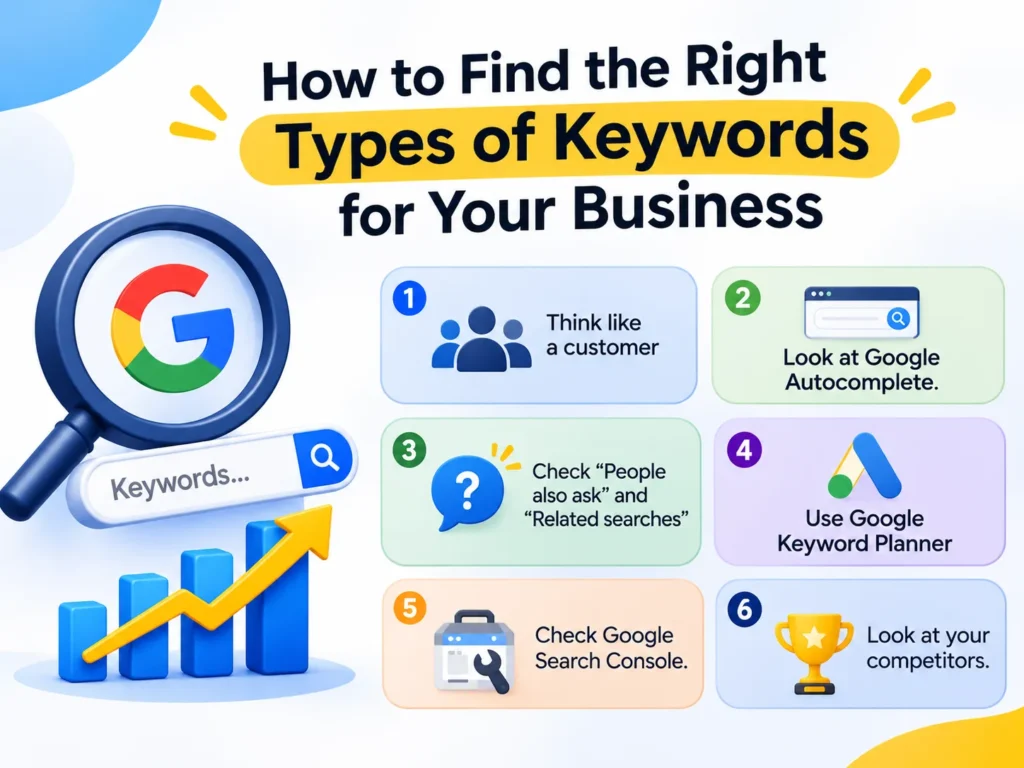
How to Find the Right Types of Keywords for Your Business
- Think like a customer. If you wanted to buy your service, what would you type into Google?
- Look at Google Autocomplete. The suggestions that appear as soon as you start typing in the search box are real searches.
- Check “People also ask” and “Related searches”. You find them in the middle of the search results and at the bottom.
- Use Google Keyword Planner. This is a free Google Ads tool (an account is needed) that gives keyword ideas.
- Check Google Search Console. It tells you which words people are already using to reach your site.
- Look at your competitors. Their website headings and pages can give you ideas.
Where to Place Keywords on Your Page
After choosing the types of keywords, it is also important to place them in the right spots on the page:
- The page title and meta description
- The URL
- The first paragraph
- A few headings (H2, H3)
- The alt text of images
Just make sure the keyword feels natural. Forcing it in again and again (keyword stuffing) reads badly, and search engines do not like it either. Write for people first, and then for search engines.
If you run Google Ads, you will also find how to work with keywords in our blog “How to Write a Google Ads Campaign That Actually Converts”.
5 Common Mistakes When Choosing Types of Keywords
- Choosing only short-tail keywords. Competition is very high, and results come with difficulty.
- Ignoring intent. Building a sales page for an informational keyword, or writing a long blog post for a transactional keyword.
- Cramming too many keywords on one page. Keep one main topic per page.
- Forgetting local keywords. For small businesses, these are the most useful.
- Choosing keywords once and forgetting them. How people search keeps changing. Check again from time to time.
ALSO READ: How to Do SEO for a New Website in 2026: A Complete Beginner’s Guide
Conclusion
Keywords are the bridge that connects your customer’s question to your answer. Understanding the types of keywords means knowing which customer is searching, when, what for and why.
Use a mix of the types of keywords instead of depending on just one type. To start, remember: begin with long-tail and local keywords, keep search intent in mind, and keep one main topic on every page.
If you want someone to find the right keywords for your business and place them on your website, contact Tarun Marketing. We build SEO strategies for local businesses in Punjab.
FAQs
1. What are keywords? Keywords are the words or phrases that people type into Google or another search engine when they want to find something.
2. How many types of keywords are there? There is no single fixed list, but generally there are short-tail and long-tail keywords by length, and informational, navigational, commercial and transactional keywords by intent. Local, branded and generic keywords are also counted as separate types.
3. What is the difference between short-tail and long-tail types of keywords? Short-tail keywords are 1 to 2 words and very broad. Long-tail keywords are 3 or more words and specific, and they usually have less competition.
4. Which types of keywords are best for a small business? Usually long-tail and local keywords, because they have less competition and bring customers who are in your area and close to buying.
5. What is search intent? Search intent is the real purpose of the person searching: to learn something, to reach a site, to compare options, or to buy.
6. How many keywords can I use on one page? Keep one main keyword (or topic) per page, and use a few related keywords naturally. Do not put many different topics on the same page.
7. Where can I find keywords? You can find keyword ideas using Google Autocomplete, “People also ask”, Google Keyword Planner and Google Search Console.
8. Does keyword stuffing improve ranking? No. Forcing a keyword in again and again makes the content read badly, and search engines do not like it either. Use it naturally, only where it is needed.
