

Imagine walking into a shop where the doors take ten seconds to open. Most people would turn around and walk to the next store. That is exactly what happens online when your website loads slowly. In a world where information is a tap away, website speed has become one of the most important factors in whether a business grows or stalls.
Many business owners spend months on design, content, and advertising, yet overlook the one thing that decides whether visitors stay long enough to see it all. Website speed is not just a technical detail for developers. It directly affects your revenue, your search rankings, your brand reputation, and your customers’ trust. In this article, we will look at why website speed matters for business growth, what slows your site down, and how you can fix it.
What Is Website Speed?
Website speed describes how quickly your web pages load and become usable for visitors. It is usually measured by page load time, the number of seconds between a user clicking a link and seeing the content fully displayed and ready to interact with.
Google measures website speed through a set of metrics called Core Web Vitals:
- Largest Contentful Paint (LCP): how fast the main content loads. A good score is under 2.5 seconds.
- Interaction to Next Paint (INP): how quickly the page responds when a user taps or clicks. A good score is under 200 milliseconds.
- Cumulative Layout Shift (CLS): how stable the page layout is while loading. A good score is under 0.1.
Together, these numbers give a clear picture of your website performance from a real user’s point of view. Improving them benefits both your visitors and your business.

1. Website Speed Shapes First Impressions
Visitors form an opinion about your brand within seconds. A fast website feels professional, reliable, and modern. A slow one feels outdated and careless, even if your product is excellent.
Research from Google has shown that as page load time increases from one second to three seconds, the probability of a visitor leaving rises by about 32 percent. Visitors rarely give a slow site a second chance. They simply click back and choose a competitor whose website speed is better. Every second of delay is a lost opportunity to make a good first impression.
2. Faster Websites Convert More Visitors
Traffic is only valuable when it turns into leads, sign-ups, or sales. This is where website speed has its most direct impact on business growth.
When a page loads quickly, users move smoothly through your site. They browse more products, read more content, and complete forms without frustration. When a page lags, they hesitate, lose patience, and abandon their carts. Studies by major retailers and analytics firms have repeatedly shown that even a delay of a few hundred milliseconds can reduce conversion rates noticeably.
Consider an online store that earns 1,000 orders a month. If improving website speed lifts the conversion rate by even a few percent, that store gains dozens of extra orders every month without spending a rupee more on advertising. Speed is one of the cheapest ways to get more value from the traffic you already have.
3. Website Speed Is a Ranking Factor in Google
Search engines want to send users to pages that give a good experience. For this reason, Google uses page experience signals, including Core Web Vitals, as part of its ranking systems. While great content and relevant links remain the most important factors, website speed can be the tiebreaker between you and a competitor with similar content.
A fast website also helps search engines crawl your pages more efficiently. When your server responds quickly, Google can crawl more of your pages in less time, which helps new content get discovered and indexed sooner. Better rankings bring more organic traffic, which means more customers finding you without paid ads. In this way, website speed supports long-term, sustainable growth.
Also Read – Google Business Profile: 15 Mistakes That Hide Your Business from Customers
4. Mobile Users Demand Fast Loading
Most web traffic today comes from smartphones, and mobile users are often on slower or unstable networks. Google’s mobile research has found that more than half of mobile visitors will leave a page that takes longer than three seconds to load.
If your business serves customers in cities and small towns alike, mobile website speed is critical. A heavy page that opens smoothly on a desktop with fibre internet may crawl on a mid-range phone with a weak 4G signal. Since Google uses mobile-first indexing, the mobile version of your site is the one that counts most for rankings. Optimising website speed for mobile is no longer optional. It is the foundation of reaching today’s customers.
5. Better User Experience Builds Loyalty
A fast website is a pleasant website. Pages open instantly, menus respond immediately, and images appear without jumping around. This smooth experience builds trust, and trust builds loyalty.
Customers who enjoy using your site are more likely to return, recommend it to friends, and buy again. On the other hand, a slow website creates frustration that people associate with your brand. They may not remember exactly what went wrong, only that your site was annoying to use. Over time, the gap between a fast brand and a slow brand shows up in repeat purchases, reviews, and word-of-mouth referrals.
6. Website Speed Affects Advertising Returns
If you run Google Ads or social media campaigns, website speed directly affects your return on investment. You pay for every click, but if the landing page takes too long to load, many of those visitors leave before the page even appears. That means wasted budget.
Google Ads also considers landing page experience when calculating Quality Score, which influences your cost per click. A faster landing page can lower your costs and improve your ad position. In short, improving website speed makes every marketing rupee work harder.
7. Common Causes of Slow Website Speed
Before you can fix the problem, you need to know what causes it. The most common culprits are:
- Large, uncompressed images: High-resolution photos are often the biggest reason for slow page load time.
- Cheap or overloaded hosting: A slow server delays everything, no matter how well your site is built.
- Too many plugins and scripts: Each extra plugin, tracking code, or widget adds weight and requests.
- No caching or CDN: Without caching, your server rebuilds each page for every visitor.
- Bloated code: Unminified CSS and JavaScript files increase download size.
- Too many redirects and third-party resources: Every additional request adds delay.
8. How to Improve Website Speed
The good news is that most website speed problems can be solved with a few practical steps:
- Optimise your images. Compress them, use modern formats like WebP, and resize them to the dimensions actually needed. Add lazy loading so images below the fold load only when users scroll to them.
- Choose quality hosting. Reliable hosting with fast response times is a smart investment. For growing businesses, managed or cloud hosting often pays for itself.
- Use a Content Delivery Network (CDN). A CDN stores copies of your site on servers around the world, so visitors load it from a location close to them.
- Enable caching. Browser and server caching let returning visitors load your pages much faster.
- Minify CSS, JavaScript, and HTML. Removing unnecessary characters and combining files reduces the amount of data users must download.
- Remove unnecessary plugins and scripts. Audit your site regularly and delete anything you do not truly need.
- Reduce redirects and limit third-party tools. Keep only the integrations that add real value.
- Prioritise mobile. Test your site on real phones and design lightweight pages for smaller screens.
9. Tools to Measure Your Website Speed
You cannot improve what you do not measure. These free tools will help you check your website speed and find specific problems:
- Google Page Speed Insights: gives performance scores and Core Web Vitals data for mobile and desktop.
- GT metrix: provides detailed load reports and waterfall charts.
- Web Page Test: lets you test from different locations and devices.
- Google Search Console: shows Core Web Vitals reports across your whole site.
Test your key pages, such as your homepage, product pages, and checkout, at least once a month, and again after every major update.
Final Thoughts
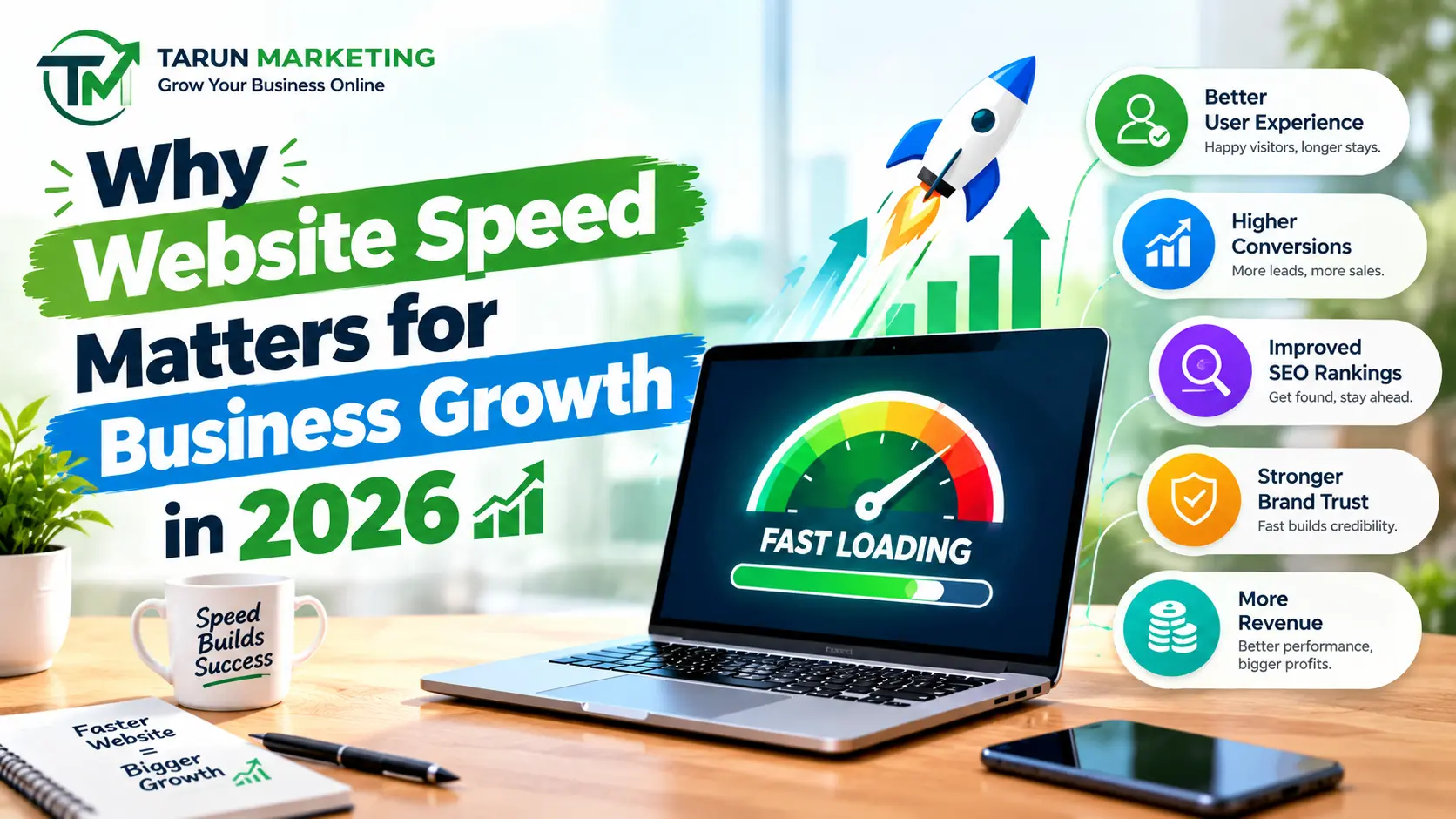
Website speed is far more than a technical score. It shapes first impressions, increases conversions, improves search rankings, lowers advertising costs, and builds lasting customer loyalty. Every one of these benefits feeds directly into business growth.
The businesses that win online are not always those with the biggest budgets, but often those that give users the smoothest experience. Start by measuring your current website speed, fix the biggest issues first, and keep monitoring performance over time. Even small improvements can bring big results.
Your customers are already deciding whether to stay or leave. Make sure your website speed gives them every reason to stay.
