
High-Converting Landing Page: 10 Essentials
A High-Converting Landing Page is one of the most powerful tools for turning website visitors into customers. Whether you’re running Google Ads, promoting your services on social media, or launching a new product, your landing page plays a crucial role in generating leads and increasing conversions.
Many businesses spend money driving traffic to their websites but fail to achieve results because their landing pages are not optimized. If you’re looking for professional Digital Marketing Services, explore our services to learn how we can help improve your online presence.
In this guide, you’ll learn the 10 essential elements that every High-Converting Landing Page should include to improve user experience, increase conversions, and help your business grow.
What Is a High-Converting Landing Page?
A High-Converting Landing Page is a dedicated web page designed with one clear goal—to encourage visitors to complete a specific action. Unlike a homepage, which offers multiple navigation options, a landing page focuses on a single objective.
That objective could be:
- Generating leads
- Booking consultations
- Downloading an eBook
- Requesting a quote
- Purchasing a product
- Signing up for a newsletter
By removing distractions and guiding visitors toward one action, landing pages achieve much higher conversion rates than standard web pages.
Why Is a Landing Page Important?
A professionally designed landing page helps businesses maximize the value of every visitor.
Some key benefits include:
- Higher conversion rates
- Better return on advertising investment
- Improved user experience
- More qualified leads
- Better campaign performance
- Easier performance tracking
Whether your visitors come from Google Ads, social media campaigns, or email marketing, an optimized landing page increases the chances of converting them into customers.
Essential 1: Write a Clear and Compelling Headline
Your headline is the first thing visitors notice. It should immediately explain what you offer and why it matters.
A strong headline should:
- Grab attention quickly
- Clearly communicate the main benefit
- Match the advertisement or campaign visitors clicked
- Use simple and direct language
For example:
Grow Your Business with Professional Digital Marketing Services
A clear headline keeps visitors engaged and encourages them to continue reading.
Essential 2: Use a Strong Call-to-Action (CTA)
Every High-Converting Landing Page needs a clear Call-to-Action (CTA). This is the button or message that tells visitors what to do next.
Examples include:
- Get Started
- Request a Free Quote
- Book a Consultation
- Contact Us Today
- Download Now
Your CTA should stand out with contrasting colors, action-oriented language, and strategic placement throughout the page.
Avoid vague buttons like “Submit.” Instead, use text that clearly communicates the benefit users will receive.
Essential 3: Focus on One Goal
One of the biggest mistakes businesses make is trying to achieve too many objectives on a single page.
A successful landing page should focus on one action only.
For example:
- If you’re offering SEO services, encourage users to request an SEO consultation.
- If you’re promoting Google Ads management, ask visitors to schedule a strategy call.
- If you’re offering website development, guide visitors toward requesting a free quote.
Keeping one clear objective reduces confusion and improves conversion rates.
Essential 4: Build Trust with Social Proof
People are more likely to trust your business when they see positive experiences from previous customers.
Add trust-building elements such as:
- Customer testimonials
- Client reviews
- Case studies
- Star ratings
- Business certifications
- Client logos
Social proof reassures visitors that your business is reliable and capable of delivering results.
Essential 5: Keep the Design Clean and Professional
A cluttered page can overwhelm visitors and reduce engagement.
Instead, focus on a clean layout that highlights the most important information.
Your landing page should include:
- Plenty of white space
- Easy-to-read fonts
- High-quality images
- Consistent brand colors
- Mobile-friendly design
- Fast loading speed
Avoid unnecessary animations, pop-ups, or excessive text that distract visitors from your primary goal.
A simple and professional design helps visitors navigate your page easily while keeping their attention on your Call-to-Action.
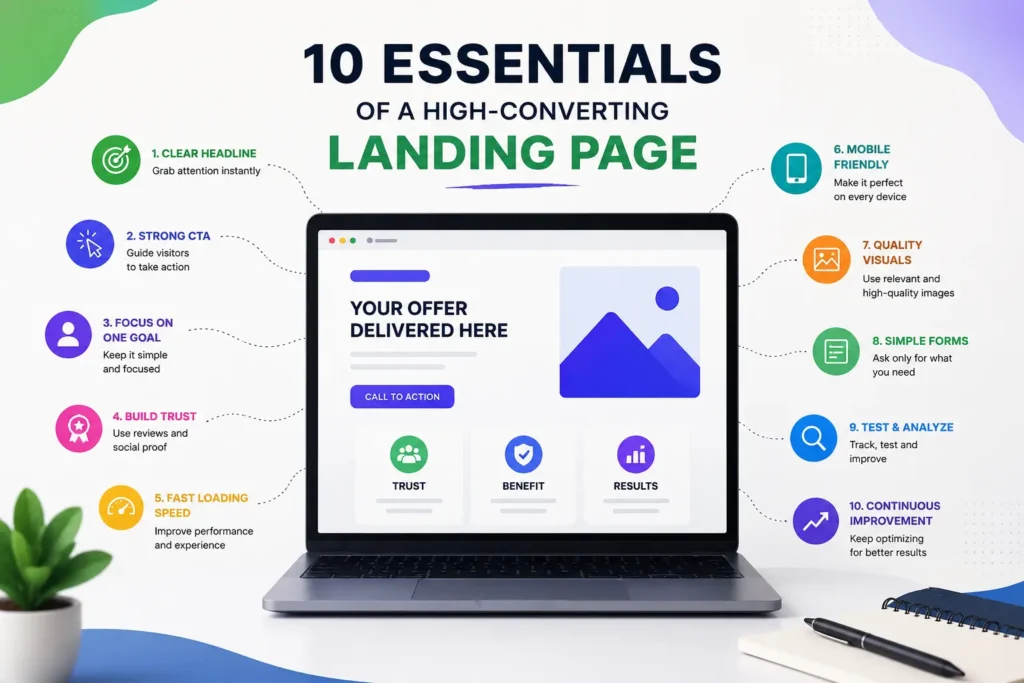
Essential 6: Optimize Page Loading Speed
A slow website can cause visitors to leave before your page even finishes loading. Speed is not only important for user experience but also plays a role in search engine rankings.
You can test your website’s performance using Google PageSpeed Insights to identify speed issues and receive optimization recommendations.
To improve loading speed:
- Compress images before uploading them.
- Minimize unnecessary CSS and JavaScript files.
- Enable browser caching.
- Use a reliable web hosting provider.
- Optimize videos and multimedia content.
A faster landing page keeps visitors engaged and increases the chances of conversions.
Essential 7: Make It Mobile-Friendly
Today, most users browse websites on smartphones and tablets. If your landing page doesn’t display properly on smaller screens, you may lose valuable customers.
A mobile-friendly landing page should have:
- Responsive design
- Easy-to-read text
- Clickable buttons
- Proper image scaling
- Fast mobile loading speed
Testing your page on different devices ensures a consistent experience for every visitor.
Essential 8: Use High-Quality Images
Visual content helps visitors understand your message faster than text alone. Professional images also improve your brand’s credibility.High-quality visuals make a High-Converting Landing Page look more professional and help build trust with potential customers.
Choose images that:
- Represent your business or services
- Support your message
- Load quickly without losing quality
- Match your brand identity
Avoid blurry or generic stock photos whenever possible. Authentic visuals often perform better and create a stronger connection with visitors.
Essential 9: Keep Forms Short and Simple
Long forms often discourage users from completing an action.
Only ask for information that is truly necessary.
For example:
- Name
- Email Address
- Phone Number
- Business Name (if required)
Reducing the number of form fields makes it easier for visitors to submit their information and improves conversion rates.
Essential 10: Test and Improve Regularly
Creating a landing page is only the beginning. Regular testing helps identify what works best for your audience.
Monitor important metrics such as:
- Conversion rate
- Bounce rate
- Time spent on page
- Button clicks
- Form submissions
You can also perform A/B testing by comparing different headlines, images, button colors, or Call-to-Action text. Small improvements often lead to better results over time.
High-Converting Landing Page Checklist
Before publishing your landing page, make sure you have included the following:
- Clear headline
- Strong Call-to-Action
- One primary goal
- Customer testimonials
- Professional design
- Fast loading speed
- Mobile-friendly layout
- High-quality images
- Simple contact form
- Regular performance testing
Using this checklist helps ensure your page is optimized for both visitors and conversions.
Common Landing Page Mistakes to Avoid
Many businesses create landing pages but fail to achieve good results because of avoidable mistakes.
Common mistakes include:
- Using multiple Call-to-Action buttons with different goals
- Writing lengthy paragraphs that overwhelm visitors
- Using low-quality or blurry images
- Ignoring mobile users
- Creating slow-loading pages
- Asking for too much information in forms
- Failing to build trust with testimonials or reviews
- Not testing page performance
Avoiding these mistakes can significantly improve your conversion rate and provide a better user experience.
Conclusion
A High-Converting Landing Page is much more than an attractive web page. It is a strategic marketing tool designed to convert visitors into leads and customers. By using a clear headline, a strong Call-to-Action, professional design, mobile-friendly layout, optimized speed, and trust-building elements, businesses can improve their online performance and achieve better marketing results.
Remember that optimization is an ongoing process. Regularly reviewing your landing page, testing new ideas, and analyzing user behavior will help you increase conversions and maximize the return on your marketing efforts.
By applying these 10 essential practices, you can create a High-Converting Landing Page that not only attracts visitors but also encourages them to take meaningful action.
Every High-Converting Landing Page should be reviewed regularly to ensure it continues delivering the best possible results.
Frequently Asked Questions (FAQs)
1. What is a High-Converting Landing Page?
A High-Converting Landing Page is a dedicated web page designed to encourage visitors to complete a specific action, such as filling out a form, requesting a quote, or making a purchase.
2. Why is a landing page important?
A professionally designed High-Converting Landing Page helps businesses maximize the value of every visitor.
3. How can I improve my landing page?
You can improve your landing page by using a clear headline, a strong Call-to-Action, fast loading speed, mobile-friendly design, quality images, and customer testimonials.
4. How often should I update my landing page?
Review your landing page regularly and update it whenever you launch new campaigns, introduce new services, or notice changes in visitor behavior and conversion rates.
