

Website Gets Traffic But No Leads: 7 Amazing Reasons in 2026
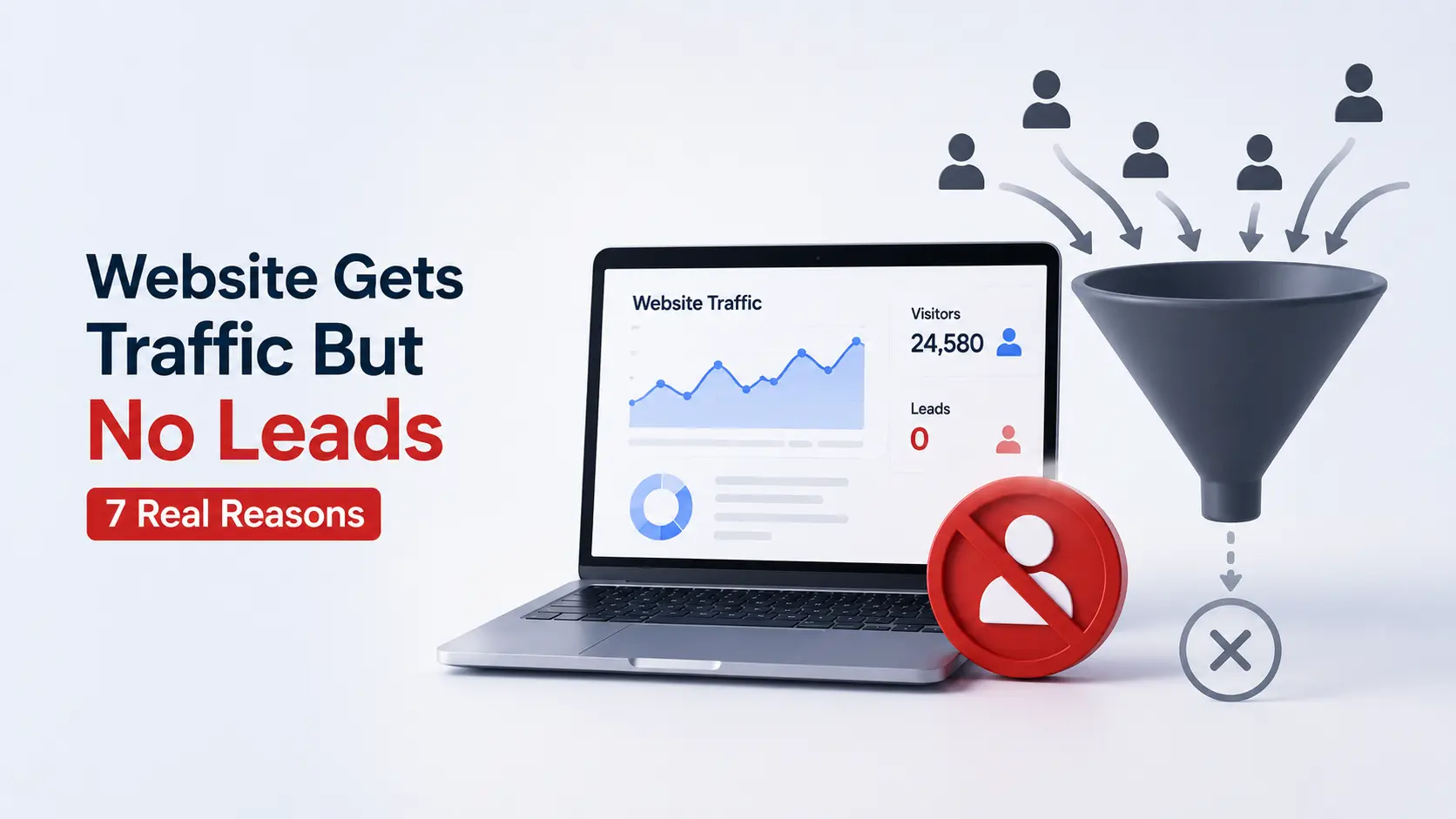
You’re getting visitors. Your analytics show steady traffic. However, your inbox stays empty, and the phone doesn’t ring. When a website gets traffic but no leads, the problem is rarely the traffic itself — it’s what happens after someone arrives.
In this guide, we’ll break down the 7 real reasons this happens, and exactly how to fix each one.
Why Traffic Alone Never Guarantees Leads
Many business owners assume more visitors automatically means more business. However, traffic only measures how many people show up — it says nothing about whether your website actually convinces them to take action.
A website gets traffic but no leads almost always points to a conversion problem, not a visibility problem. Understanding this distinction is the first step toward fixing it.
Reason 1: Unclear Value Proposition
If visitors can’t understand what you offer within a few seconds, they leave immediately. Therefore, this is often the single biggest reason a website gets traffic but no leads despite steady visitor numbers.
- Visitors need to instantly understand what problem you solve
- Vague, generic messaging fails to capture attention quickly enough
- Fix: Rewrite your headline to clearly state what you do and who it’s for
Reason 2: Weak or Missing Calls to Action
Many pages inform or entertain but never guide the visitor toward a specific next step. Consequently, even interested visitors leave without knowing what to do.
- Pages without a clear CTA leave conversion up to chance
- Vague CTAs like “Learn More” underperform specific ones
- Fix: Add a clear, direct CTA like “Get a Free Quote” on every page
Reason 3: Slow Page Load Times
Even a one or two second delay significantly increases bounce rates. As a result, a slow website gets traffic but no leads simply because visitors leave before they even see your offer.
- Mobile users are especially impatient with slow loading
- Every additional second of load time reduces conversion likelihood
- Fix: Compress images and minimize unnecessary scripts to improve speed
Reason 4: Poor Mobile Experience
Most traffic today arrives through mobile devices. However, a site that isn’t fully optimized for mobile — awkward navigation, tiny text, slow loading — loses potential leads regardless of desktop quality.
- Mobile-unfriendly forms are especially costly for lead generation
- Difficult navigation frustrates users into leaving
- Fix: Test your site thoroughly on multiple mobile devices, not just desktop

Website Traffic vs Leads: Common Gaps
| Traffic Element | What It Measures | What It Misses |
|---|---|---|
| Visitor Count | How many people arrive | Whether they trust you |
| Time on Page | Engagement duration | Whether they take action |
| Bounce Rate | Immediate exits | Why they left specifically |
| Page Views | Content exploration | Actual conversion intent |
Overall, this table shows why a website gets traffic but no leads when businesses only track visibility metrics without measuring actual conversion behavior.
Reason 5: No Visible Trust Signals
Visitors hesitate to contact a business that doesn’t clearly show credibility. Without reviews, testimonials, or clear contact information, even genuinely interested visitors stay cautious.
- Missing trust signals create unnecessary hesitation
- Visible reviews near your CTA can meaningfully boost conversions
- Fix: Add testimonials, certifications, or case studies near key decision points
Reason 6: Complicated Contact Forms
Long, complex forms asking for unnecessary information discourage completion. Therefore, a website gets traffic but no leads partly because the final step to convert feels like too much effort.
- Every additional form field reduces completion rates
- Asking for unnecessary details creates unneeded friction
- Fix: Keep forms short, asking only for essential contact information
Reason 7: Generic, Untargeted Messaging
Content that speaks broadly instead of addressing specific customer pain points fails to resonate. Consequently, visitors read generic content without feeling personally addressed.
- Vague messaging fails to connect with actual customer concerns
- Specific pain-point language performs significantly better
- Fix: Rewrite key pages using the exact words your customers actually use
How These Reasons Compound Together
Individually, each of these issues might seem minor. However, together, they create a compounding effect where even genuinely interested visitors face multiple small frictions before ever reaching out. This is precisely why a website gets traffic but no leads even when no single problem seems severe on its own.
Also Read – Ads Get Clicks But Fewer Sales: 7 Amazing Reasons in 2026
Common Mistakes Businesses Make
- Focusing entirely on driving more traffic instead of fixing conversion issues
- Assuming a redesign is needed when small fixes would work
- Never testing different headlines or calls to action
- Ignoring mobile experience while focusing only on desktop
- Not tracking where visitors actually drop off before leaving
How to Start Diagnosing Your Own Website
- Review analytics to identify your highest-traffic, lowest-converting pages
- Test your site’s speed using a free tool like Google PageSpeed Insights
- Check your site thoroughly on an actual mobile device, not just a simulator
- Simplify your primary contact or inquiry form
- Add at least one clear trust signal near your main call to action
This diagnostic approach helps identify exactly why your website gets traffic but no leads, rather than guessing at random fixes.
Why Fixing This Matters More Than Driving More Traffic
Many businesses respond to low leads by investing more in advertising or SEO to drive additional traffic. However, if the underlying conversion issues remain unaddressed, more traffic simply means more visitors experiencing the same friction points, without meaningfully improving results.
Therefore, fixing conversion issues first often delivers a better return than simply increasing traffic to an already leaking funnel.
Final Thoughts
A website gets traffic but no leads almost always points to friction somewhere between arrival and conversion — unclear messaging, weak calls to action, slow speed, or missing trust signals. These issues are rarely dramatic on their own, but together, they quietly prevent visitors from ever reaching out.
Businesses that systematically address these seven reasons typically see meaningful improvement in leads, often without needing to increase traffic at all.
Not sure why your website isn’t converting despite steady traffic? Get in touch with me for a quick conversion review.
Frequently Asked Questions (FAQs)
1. Why does my website get traffic but no leads?
This usually points to a conversion issue, not a traffic issue — unclear messaging, weak calls to action, slow loading, or missing trust signals are the most common causes.
2. How important is page speed for lead generation?
Very important. Even small delays in loading time significantly increase bounce rates, meaning visitors leave before ever seeing your offer.
3. Do I need a website redesign to fix low conversions?
Not necessarily. Often, targeted fixes like clearer calls to action, simplified forms, and added trust signals resolve the issue without a full redesign.
4. Why do complicated contact forms hurt conversions?
Every additional form field creates friction, reducing the likelihood a visitor completes it. Shorter, simpler forms typically convert significantly better.
5. How can I identify where visitors are dropping off?
Reviewing analytics for high-traffic, low-conversion pages, along with tools that track scroll depth and click behavior, helps pinpoint exactly where visitors lose interest.
6. Should I focus on more traffic or fixing conversions first?
Fixing conversion issues first typically delivers better results, since driving more traffic to a page with existing friction points simply repeats the same problem at a larger scale.
7. How long does it take to see improvement after fixing these issues?
Many businesses notice improved conversion rates within a few weeks of implementing these fixes, though results can vary based on traffic volume and the specific issues address
