


Google Ads for Local Businesses: Proven Strategy for Small Cities
Google Ads for local businesses works differently than campaigns built for big metro cities. Search volumes are lower, competition looks different, and customer behavior often doesn’t match strategies designed for Mumbai, Delhi, or Bangalore. If you’ve copied a “big city” approach and seen disappointing results, the problem usually isn’t your budget — it’s your strategy.
Why Standard Strategies Fail for Google Ads for Local Businesses
Most Google Ads guides are written with metro audiences in mind — high search volume, intense competition, and users already comfortable clicking ads and buying online. Running Google Ads for local businesses in smaller cities faces a different reality: lower search volume for broad keywords, price-sensitive customers who research more before converting, and often a mix of Hindi, English, and regional language searches. According to Google’s Think with Google research, users in smaller cities increasingly research locally before making purchase decisions, making hyper-local targeting essential rather than optional.
Focus on Hyper-Local Keywords, Not Broad Terms
In smaller cities, broad keywords like “digital marketing agency” simply don’t have enough search volume to justify big spend, and the competition that does exist is often poorly targeted. Instead, hyper-local keywords — phrases that include your city, locality, or landmark names — tend to perform far better. A search like “best dentist near Sector 17 Chandigarh” has far less competition and much higher intent, making it a smarter investment for Google Ads for local businesses operating outside metro areas.
Prioritize Call Extensions Over Website Clicks
Many businesses in smaller cities get more value from phone calls than website visits. Customers in these markets often prefer speaking directly to a business before committing, especially for services like healthcare, real estate, or home repair. Setting up call extensions ensures your budget goes toward driving direct inquiries rather than clicks that never convert into leads.
Use Radius Targeting Instead of City-Wide Targeting
City-wide targeting often wastes budget in smaller markets because customers rarely travel far for local services. Setting a tighter radius — often 5 to 15 kilometers depending on your business type — keeps ads focused on people who can realistically become customers. This is one of the fastest ways to improve efficiency when running Google Ads for local businesses in smaller markets.
Test Regional Language Ad Copy
A significant portion of searchers in smaller cities search and think in regional languages, even when typing in English script. Testing ad copy that includes regional language phrases alongside English can noticeably improve click-through rates. Google Ads supports multiple language targeting, and businesses that experiment with this often see better engagement than those running English-only campaigns.
Lower Your Budget Expectations, Not Your Standards
One common mistake is assuming that smaller markets require the same daily budgets as metro campaigns. In reality, Google Ads for local businesses in Tier 2 and Tier 3 cities often needs significantly smaller budgets to generate meaningful results because CPCs are typically lower and competition is thinner. A well-optimized campaign with a modest daily budget can outperform a poorly targeted big-budget campaign.
Leverage Google Business Profile Alongside Ads
Google Ads performs better when paired with a strong Google Business Profile listing. In smaller cities, customers frequently check reviews, photos, and business hours before calling or visiting. Ensuring your profile is complete and regularly updated creates a stronger overall presence and improves trust — particularly important in markets where word-of-mouth carries significant weight.
Track Calls and Store Visits, Not Just Clicks
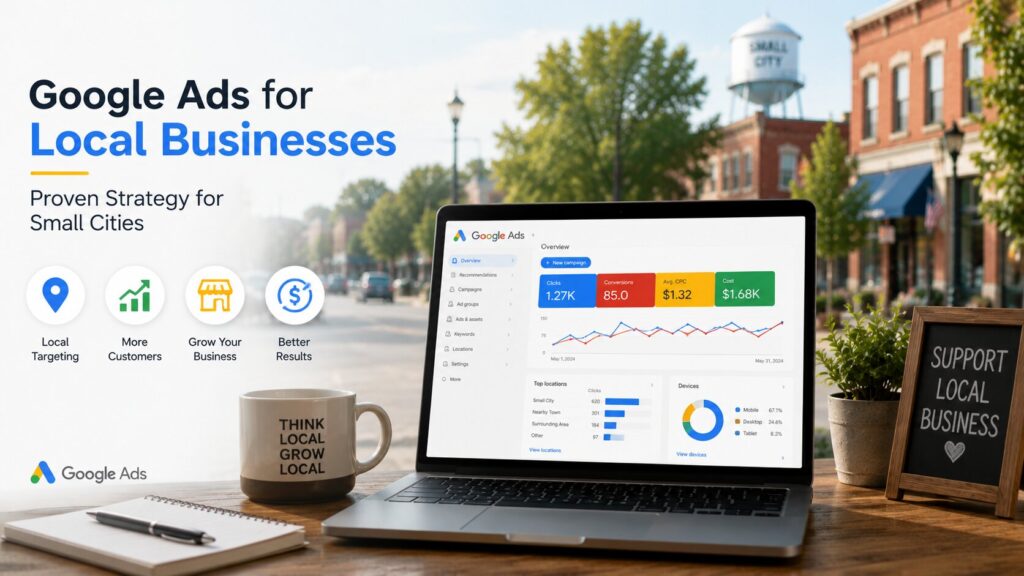
For many local businesses, especially in smaller cities, conversions happen offline — through phone calls or in-person visits rather than online purchases. Setting up call tracking and store visit tracking gives a far more accurate picture of what’s actually working for solely on click data can make an effective campaign look like it’s underperforming. .Google Ads for local businesses.
Be Patient With Data Collection
Lower search volumes mean it takes longer to gather statistically meaningful data in smaller cities compared to metro campaigns. A Tier 3 city campaign may need three to four weeks before trends become reliable. Avoid making major changes too early, and give campaigns enough time to gather sufficient data before optimizing.
Final Thoughts
Google Ads for local businesses works best when the strategy is built around local realities rather than borrowed metro playbooks. Hyper-local keywords, tighter radius targeting, call-focused campaigns, and patience with data collection all play a bigger role than raw budget size.
Frequently Asked Questions
Do Google Ads work well for businesses in smaller Indian cities?
Yes, often more efficiently than in metro areas. Lower competition typically means lower cost per click, and hyper-local targeting allows businesses to reach highly relevant customers without competing against large budgets from bigger companies.
How much budget do I need for Google Ads for local businesses in smaller cities?
Budgets can often be significantly smaller than metro campaigns, sometimes starting from a few hundred rupees per day, since CPCs tend to be lower and competition is thinner.
Should I use regional language keywords in my ads?
It’s worth testing. Many searchers in smaller cities think and search in regional languages even when using English script, and ads that reflect this often see improved engagement.
Is Local Service Ads better than regular Search Ads for local businesses?
It depends on your industry and availability in your city. Local Service Ads tend to work well for phone-inquiry-heavy businesses, while Search Ads offer more flexibility.
How long before I see results from Google Ads for local businesses?
Smaller cities generally need three to four weeks for meaningful data, compared to metro campaigns, due to lower search volumes.
What’s the biggest mistake local businesses make with Google Ads?
Applying metro-city strategies directly to smaller markets — overly broad keywords, city-wide targeting instead of a tighter radius, and unrealistic budget expectations.
