

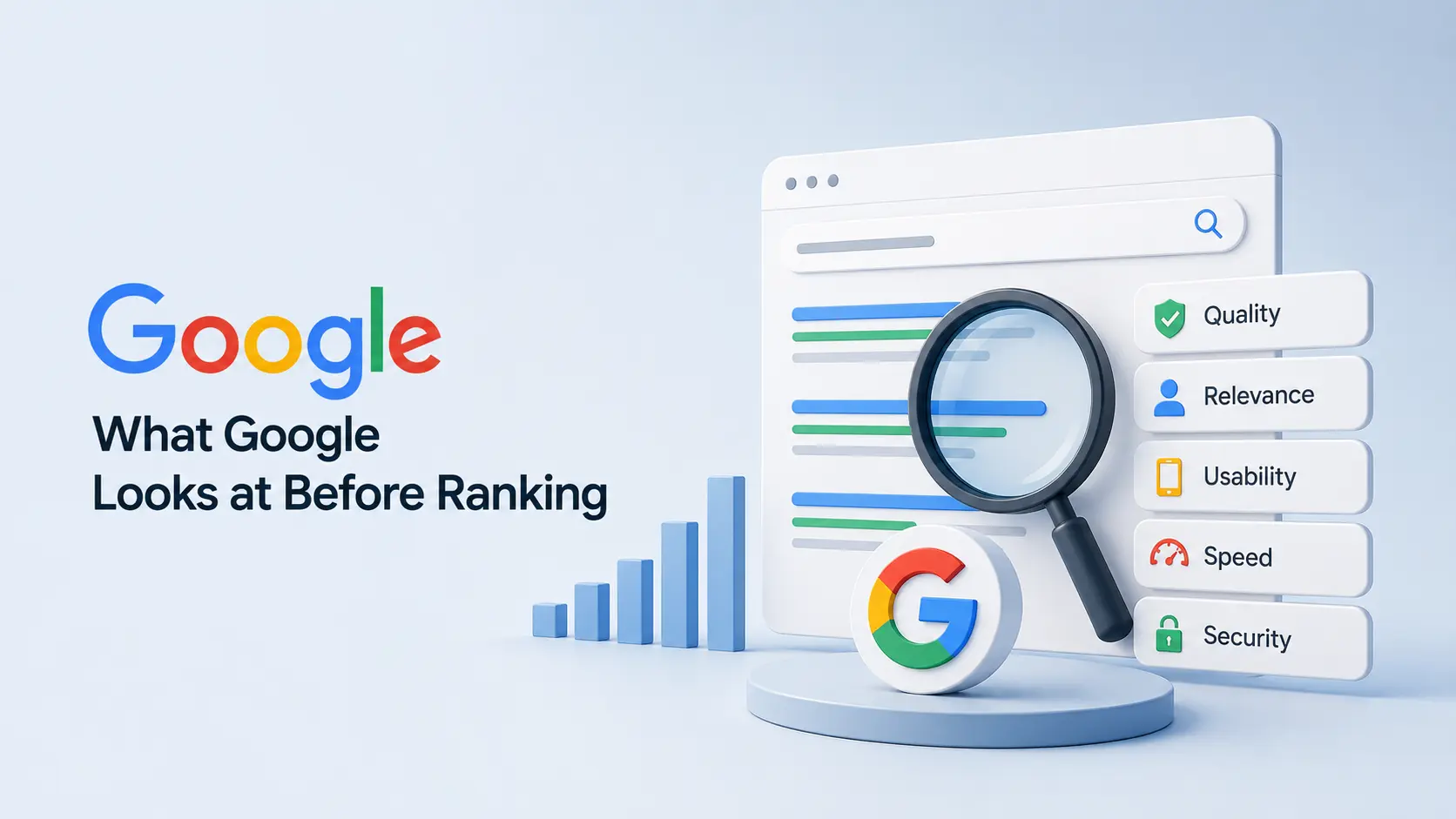
What Google Looks at Before Ranking: 7 Amazing Factors
Most businesses assume Google ranks pages purely based on keywords. However, what Google looks at before ranking a page involves dozens of factors working together, many of which have nothing to do with keyword count at all.
In this guide, we’ll break down what actually happens before Google decides where your page belongs in search results, and why some genuinely well-written pages still don’t rank.
Why Keywords Alone Don’t Determine Rankings
Many businesses still believe repeating a keyword frequently guarantees better rankings. However, Google’s algorithm has evolved significantly beyond simple keyword matching, evaluating content quality, relevance, and user experience together.
Understanding what Google looks at before ranking requires letting go of outdated assumptions and focusing on what actually influences modern search results.
Factor 1: Content Relevance to Search Intent
Google first evaluates whether your content genuinely matches what someone searching that term actually wants. This goes beyond keyword matching into understanding the underlying purpose behind a search.
- A page must answer the specific question being asked
- Content mismatched with intent rarely ranks, regardless of keyword optimization
- Google increasingly understands context, not just exact word matches
Therefore, what Google looks at before ranking starts with genuine relevance, not just keyword presence.
Factor 2: Page Experience and Core Web Vitals
Google measures how a page actually performs for real visitors — loading speed, visual stability, and interactivity. These technical signals directly influence ranking potential, independent of content quality.
- Slow-loading pages often rank lower, even with excellent content
- Visual shifts during loading create poor user experience signals
- Mobile performance matters as much as desktop performance
Consequently, technical performance remains a core part of what Google looks at before ranking any page, regardless of how well-written it is.
Factor 3: Backlink Quality, Not Just Quantity
Google evaluates the quality and relevance of websites linking to your page, not simply how many backlinks exist. A few links from trusted, relevant sources often outweigh dozens of low-quality links.
- Links from relevant, authoritative sites carry more weight
- Irrelevant or spammy backlinks can actually harm rankings
- Natural link growth over time signals genuine authority
This is one of the most misunderstood aspects of what Google looks at before ranking, since many businesses still chase link quantity over quality.
What Google Actually Prioritizes: Quick Comparison
| Factor | Old Assumption | What Actually Matters in 2026 |
|---|---|---|
| Keywords | Repeat frequently | Match search intent naturally |
| Backlinks | More links = better | Quality and relevance matter most |
| Content Length | Longer always wins | Length matches what the query needs |
| Page Speed | Nice to have | Direct ranking factor |
| Mobile Experience | Secondary concern | Equally weighted with desktop |
Overall, this table shows how what Google looks at before ranking has shifted significantly from older SEO assumptions still common today.

Factor 4: Content Depth and Comprehensiveness
Google favors content that thoroughly covers a topic rather than skimming the surface. However, this doesn’t mean longer is always better — it means the content should fully address what someone searching would want to know.
- Thin content often struggles to rank for competitive terms
- Comprehensive coverage signals genuine expertise on a topic
- Content should answer follow-up questions a reader might have
Therefore, depth becomes a meaningful part of what Google looks at before ranking competitive search terms specifically.
Factor 5: User Engagement Signals
Also Read – How Long Should You Wait Before Giving Up on SEO?
Google observes how users interact with search results, including whether they click, how long they stay, and whether they return to search again quickly. These behavioral signals indirectly influence how pages are evaluated over time.
- Pages that satisfy searchers tend to see users stay longer
- Quick returns to search results can signal unmet expectations
- Click-through rate from search results also plays a role
As a result, genuine user satisfaction has become part of what Google looks at before ranking, even though it isn’t a factor businesses can directly control through content alone.
Factor 6: Website Structure and Crawlability
Google needs to actually find and understand your content before it can rank it. Clear site structure, proper internal linking, and accessible navigation all support this process.
- Poor site structure can prevent pages from being indexed properly
- Broken links and dead ends confuse both users and search crawlers
- Clear navigation helps Google understand page relationships
Consequently, technical accessibility remains a foundational part of what Google looks at before ranking, regardless of content quality.
Factor 7: E-E-A-T: Experience, Expertise, Authority, Trust
Google increasingly evaluates whether content demonstrates genuine experience and expertise, particularly for topics affecting health, finance, or major life decisions. Trust signals like author credibility and transparent sourcing matter here.
- Content showing real, first-hand experience often performs better
- Author expertise and transparency build credibility signals
- Trustworthy, accurate information is prioritized over generic content
This factor has become increasingly central to what Google looks at before ranking, especially as AI-generated content has become more common online.
Also Read – Tarun Marketing Services: SEO, Ads & Design Work
Why Some Well-Written Pages Still Don’t Rank
Understanding these factors explains why quality writing alone isn’t enough. A beautifully written page with poor site speed, weak backlink profile, or mismatched search intent can still struggle to rank, regardless of how well the actual sentences are constructed.
This is precisely why what Google looks at before ranking requires a holistic approach rather than focusing on just one element in isolation.
Common Mistakes Businesses Make
- Focusing exclusively on keyword density while ignoring technical performance
- Chasing backlink quantity instead of relevance and quality
- Writing content that doesn’t match actual search intent
- Ignoring mobile page speed and experience
- Publishing thin content on competitive topics
How to Apply This to Your Own Website
- Audit your top pages for loading speed using free tools
- Review whether content genuinely matches search intent, not just keywords
- Check your backlink profile for quality over sheer quantity
- Ensure clear site navigation and internal linking
- Add genuine expertise, examples, or first-hand insight where relevant
This practical approach ensures you’re addressing what Google looks at before ranking, rather than relying on outdated tactics that no longer carry the same weight.
Final Thoughts
What Google looks at before ranking a page involves far more than keywords alone. Content relevance, technical performance, backlink quality, user engagement, and demonstrated expertise all work together to determine where a page ultimately lands in search results.
Businesses that address these factors holistically, rather than focusing on just one element, typically see stronger, more sustainable rankings over time.
Not sure how your website measures up against these ranking factors? Get in touch with me for a quick SEO review.
Frequently Asked Questions (FAQs)
1. Do keywords still matter for Google rankings?
Yes, but matching search intent matters more than keyword repetition alone. Google evaluates whether content genuinely answers what someone is searching for.
2. How important is page speed for rankings?
Very important. Page speed is a confirmed ranking factor, and slow-loading pages often struggle to rank well, even with strong content.
3. Is backlink quantity or quality more important?
Quality matters significantly more. A few relevant, authoritative backlinks typically outperform many low-quality or irrelevant links.
4. Does longer content always rank better?
Not necessarily. Content length should match what the search query actually requires, rather than being artificially lengthened.
5. What is E-E-A-T and why does it matter?
E-E-A-T stands for Experience, Expertise, Authority, and Trust. Google increasingly evaluates these signals, especially for topics involving health, finance, or major decisions.
6. Can good content alone guarantee good rankings?
No. Technical factors like site speed, structure, and backlink quality also play significant roles alongside content quality.
7. How often does Google update its ranking factors?
Google regularly refines its algorithm throughout the year, though core principles like relevance, quality, and user experience remain consistently important.
