

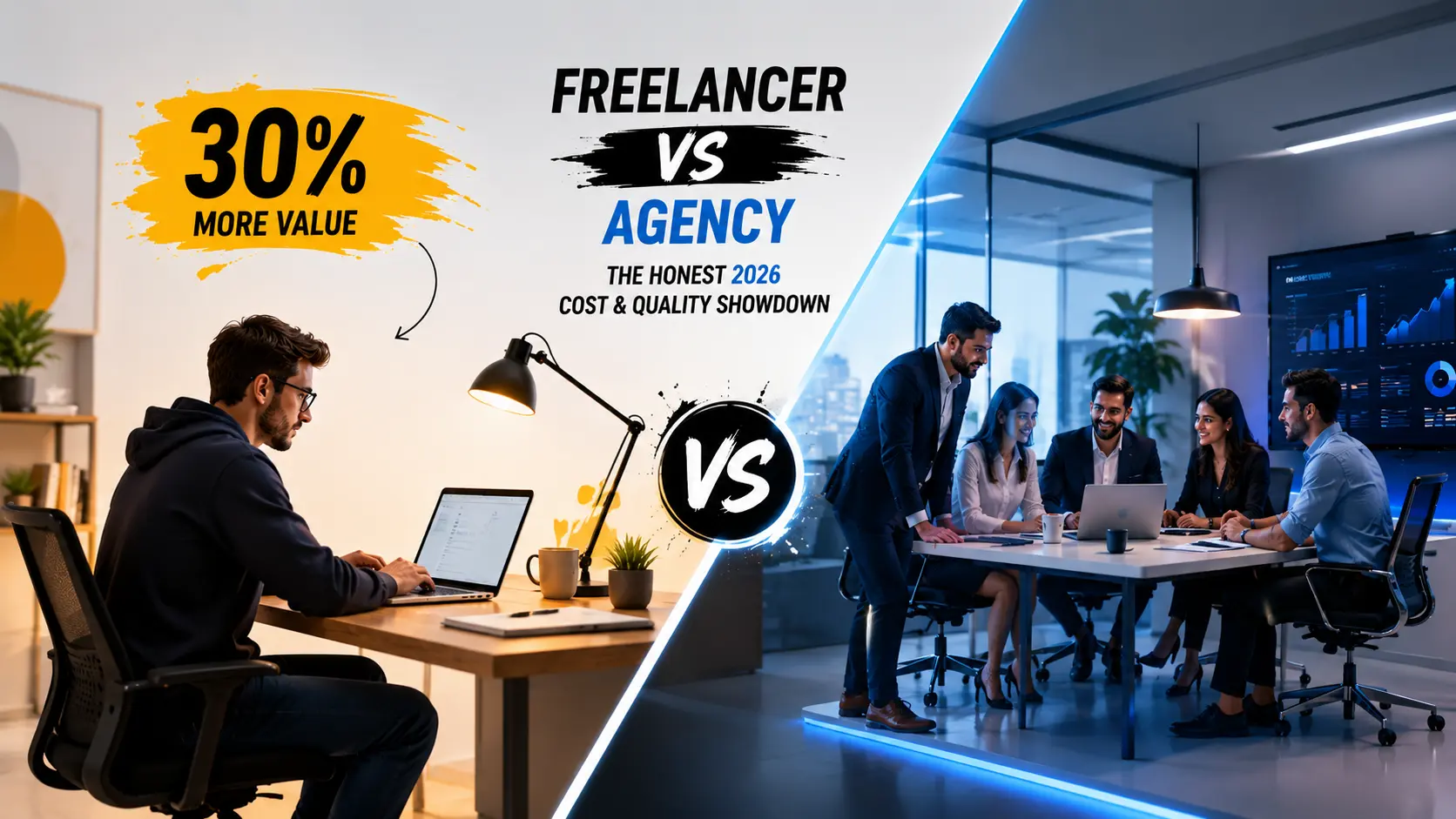
Freelancer vs Agency: The Honest 2026 Cost & Quality Showdown
Choosing between a freelancer vs agency is one of the biggest decisions a business makes before starting any marketing, design, or development project. Both options can deliver great results. However, they work in very different ways.
In this guide, we’ll break down the freelancer vs agency debate honestly — covering cost, speed, quality, and communication — so you can decide what actually fits your business.
What Does Hiring a Freelancer Actually Mean?
A freelancer is an independent professional who works directly with you, without a company or team layer in between.
You communicate with the exact person doing the work. As a result, there’s no account manager, no handoff between departments, and no added markup for overhead.
Benefits of Hiring a Freelancer
- Direct communication with the person doing the work
- Generally lower cost, since there’s no agency overhead
- Faster turnaround on smaller projects
- More flexible scheduling
- Personalized attention to your specific project
- Often more affordable for ongoing, smaller-scale work
What Does Hiring an Agency Actually Mean?
An agency is a company with a team of specialists — designers, developers, strategists, and account managers — working together on your project.
Instead of one person handling everything, different specialists handle different parts. Consequently, agencies can often manage larger, more complex projects that need multiple skill sets at once.
Benefits of Hiring an Agency
- Access to a full team of specialists
- Better suited for large-scale or complex projects
- Built-in backup if one team member is unavailable
- Established processes and project management systems
- Often more experience with bigger brands
- Generally more accountability through contracts and account managers
Freelancer vs Agency: Key Differences
| Factor | Freelancer | Agency |
|---|---|---|
| Cost | Generally lower | Generally higher |
| Speed | Faster for small projects | Slower due to layers |
| Communication | Direct, one-on-one | Through account manager |
| Team Size | Just one person | Multiple specialists |
| Scalability | Limited | High |
| Flexibility | Very flexible | Structured processes |
| Best For | Small to mid-size projects | Large, complex projects |
Overall, this table captures the core of the freelancer vs agency decision. Still, the right answer depends on your project’s size and complexity.
Freelancer vs Agency: Cost Comparison in 2026
Freelancer Costs
Freelancers typically charge less because they don’t carry the overhead of office space, multiple salaries, or account management layers.
For instance, a freelance designer might charge a flat project rate, while an agency quoting the same project often adds costs for strategy, account management, and internal coordination.
Agency Costs
Agencies charge more. However, that additional cost often reflects broader capability — multiple specialists, established workflows, and the ability to handle larger scope simultaneously.
According to general industry pricing patterns, agency retainers can run several times higher than a comparable freelancer engagement for the same deliverable, primarily due to overhead and team structure.
Also Read – How Much Should Graphic Design Really Cost? A Realistic Price Breakdown
Which Option Delivers Faster Results?
Speed depends heavily on project size and complexity.
- Need something small and quick? A freelancer usually delivers faster since there’s no internal handoff process.
- Running a large, multi-part campaign? An agency’s team structure allows parallel work across specialists, which can actually be faster at scale.
- Need urgent, one-off work? Freelancers often respond and start faster, since there’s no onboarding process through an account manager.
- Need long-term, ongoing support? Agencies typically offer more structured processes for consistent delivery over time.
6 Real Differences in Cost, Speed & Quality
- Cost structure — freelancers charge per project or hour directly; agencies often add strategy and management fees on top of production costs
- Turnaround time — freelancers are typically faster for small projects; agencies can be faster at scale due to parallel teams
- Communication layers — freelancers offer direct access; agencies route communication through account managers, which can slow decisions
- Quality consistency — agencies often have review processes and multiple eyes on work; freelancer quality depends entirely on that one person
- Scalability — agencies can handle sudden scope increases more easily; freelancers may struggle if a project suddenly grows significantly
- Accountability — agencies typically operate under formal contracts with defined deliverables; freelancer accountability varies based on individual professionalism
Altogether, weighing these six factors makes the freelancer vs agency decision much clearer for your specific situation.
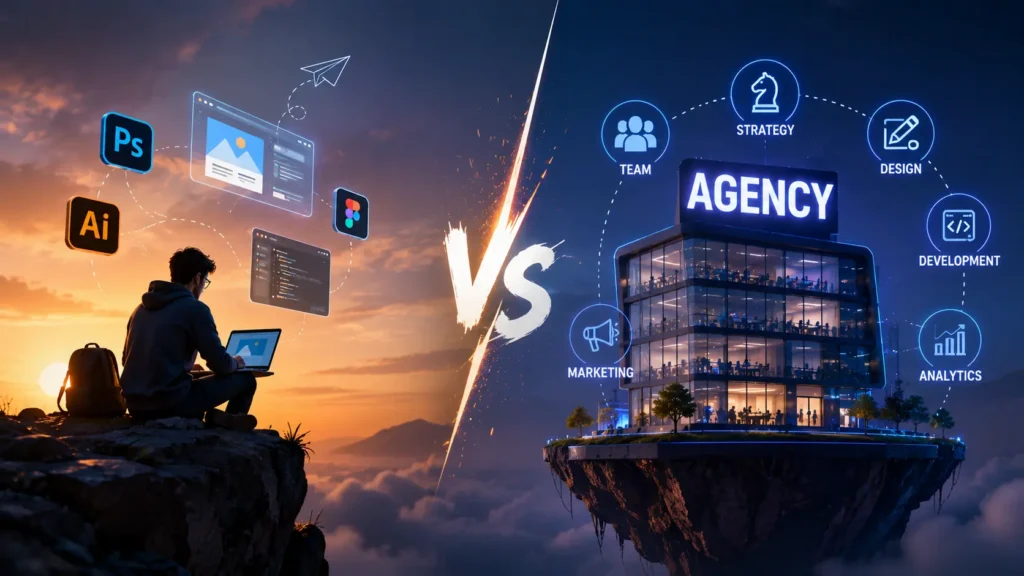
Can You Use Both a Freelancer and an Agency Together?
Yes — and, in fact, many businesses do exactly this.
- Freelancers handle smaller, specific tasks needing quick turnaround
- Agencies manage larger, ongoing campaigns needing multiple specialists
- Freelancers can supplement agency work during high-demand periods
- Agencies sometimes subcontract freelancers themselves for specialized tasks
As a result, combining both can offer flexibility for smaller needs alongside structure for bigger, ongoing projects.
How Communication Differs Between the Two
With a freelancer, you’re speaking directly to the person doing the actual work. Therefore, feedback loops are usually faster, and there’s no risk of information getting lost between departments.
With an agency, communication typically flows through an account manager who relays information to the actual specialists. This adds a layer of coordination, which can slow down quick decisions but also ensures more structured documentation of requests and changes.
Quality Control: What Actually Differs
Freelancer quality depends entirely on that individual’s skill, experience, and workload at the time. A great freelancer can deliver excellent, personalized work. However, quality can vary if they’re juggling too many projects at once.
Agencies typically have internal review processes — a second designer checking work, a project manager reviewing deliverables before client handoff. Consequently, this can catch errors before you ever see them, though it doesn’t guarantee superior creative quality compared to a skilled freelancer.
Common Mistakes Businesses Make
- Choosing based on price alone without considering project complexity
- Assuming agencies always deliver better quality than freelancers
- Assuming freelancers can’t handle larger projects
- Not checking a freelancer’s portfolio and reviews before hiring
- Not clarifying revision policies with either option before starting
- Underestimating communication time added by agency account layers
Which Option Is Best for Small Businesses?
For small businesses with limited budgets, the freelancer vs agency decision often comes down to project scope:
- Choose a freelancer for smaller projects, quick turnarounds, or ongoing work with a single specialist
- Choose an agency for larger campaigns needing multiple skill sets simultaneously
- Start with a freelancer to test working relationships before committing to bigger agency retainers
- Scale up to an agency only once project complexity genuinely requires a full team
This staged approach helps small businesses avoid overspending on agency overhead before their project actually needs that level of structure.
Measuring Success With Either Option
With freelancers, success is often measured through direct deliverable quality, turnaround time, and communication responsiveness.
With agencies, success typically includes additional metrics like reporting consistency, strategic input, and how well the account management process runs alongside the actual creative or technical output.
Therefore, tracking the right expectations for each option prevents businesses from unfairly judging one against the other using mismatched standards.
Final Verdict
Ultimately, when comparing freelancer vs agency, there’s no universal winner. Both options serve different project needs.
If you need cost-effective, direct, and flexible work, a freelancer is usually the better choice.
If you need a full team handling complex, large-scale work, an agency is the smarter investment.
For many growing businesses, starting with a freelancer and transitioning to an agency as needs scale offers the best balance of cost and capability over time.
Not sure which option fits your specific project? Get in touch with me for a quick assessment.
Frequently Asked Questions (FAQs)
1. Is a freelancer cheaper than an agency?
Generally yes. Freelancers don’t carry agency overhead like office space or multiple salaries, which typically makes their rates lower for comparable work.
2. Can a freelancer handle a large project?
It depends on the individual and project scope. Some experienced freelancers manage large projects well, though very complex projects often benefit from an agency’s team structure.
3. Which option delivers faster results?
Freelancers are usually faster for small, single-deliverable projects, while agencies can be faster for large, multi-part campaigns due to parallel team capacity.
4. Is agency work always higher quality than freelancer work?
Not necessarily. Quality depends on the specific freelancer’s skill or the specific agency’s team, rather than the business model itself.
5. Can I switch from a freelancer to an agency later?
Yes. Many businesses start with a freelancer for smaller needs and transition to an agency once project complexity or scale genuinely requires a full team.
6. Do agencies offer better accountability than freelancers?
Often, yes, through formal contracts and account management structures, though a professional freelancer can offer similar accountability through clear agreements and communication.
