

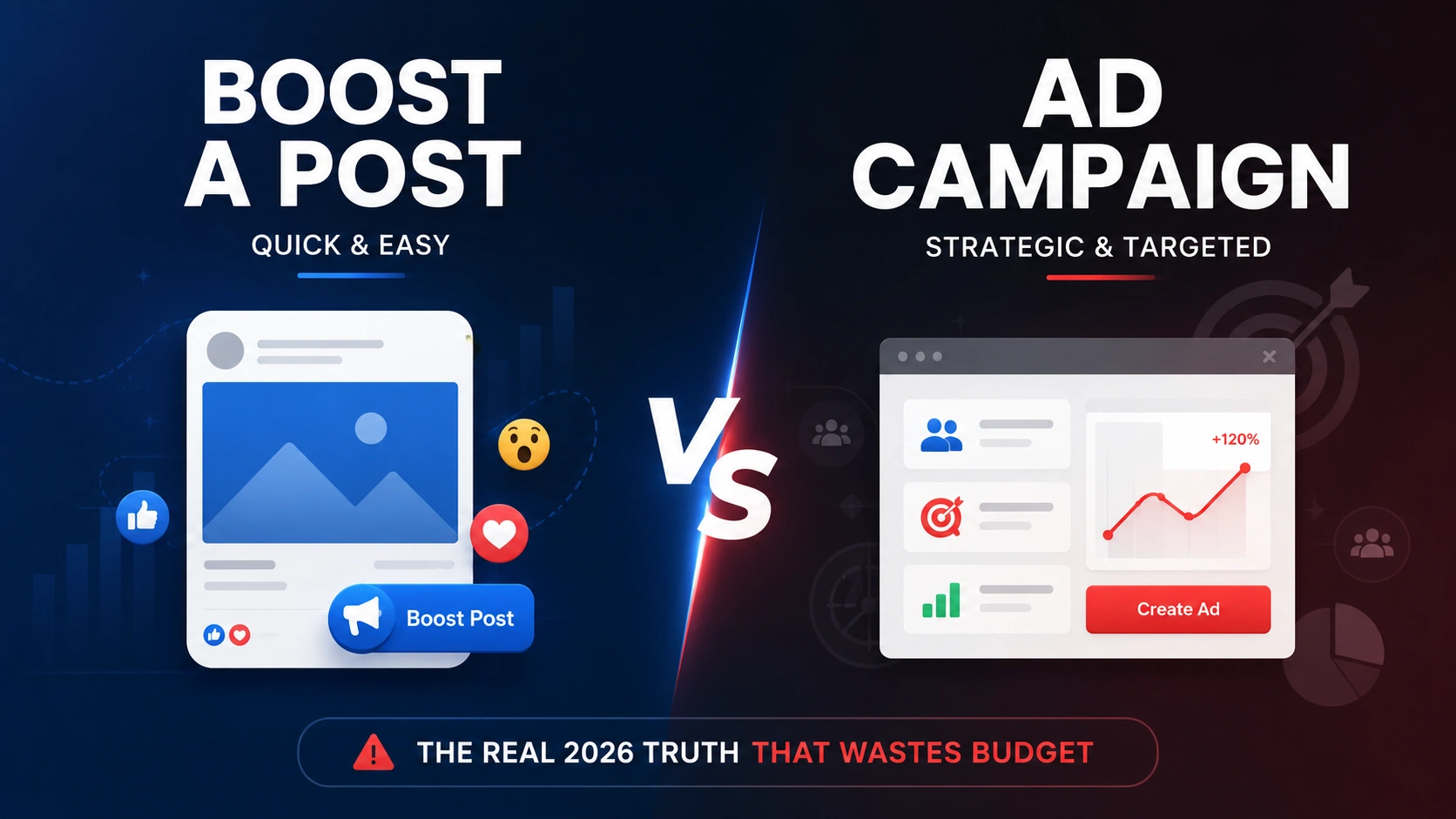
Boost a Post vs Ad Campaign: The Real 2026 Truth That Wastes Budget
You’ve probably seen the blue “Boost Post” button sitting right under your Instagram or Facebook post. It looks simple. One click, and suddenly more people see your content.
But boost a post vs ad campaign is actually a much bigger decision than that button makes it seem. Understanding what really happens behind each option can save you money and get you far better results.
Why This Confusion Costs Businesses Money
Many small business owners boost posts regularly, assuming it’s essentially the same as running ads. However, this misunderstanding often means spending money without getting the strategic results a real ad campaign could deliver.
The boost a post vs ad campaign decision matters because each option uses fundamentally different targeting, objectives, and optimization tools. Meta designed boosting to be approachable for beginners. However, that same approachability quietly limits what businesses can actually accomplish with their ad spend. Many people search specifically for boosting posts vs Facebook ads to understand this exact confusion before spending their budget.
What Actually Happens When You Boost a Post
Boosting a post is designed for simplicity. You select an existing post, choose a basic audience, set a budget, and Meta shows it to more people.
- Limited to basic targeting options like age, location, and general interests
- Optimized mainly for engagement, not necessarily conversions
- Quick to set up, often within a few clicks
- Uses a simplified version of Meta’s ad system
- Runs directly from the post itself, without needing Ads Manager
This simplicity is exactly why boosting feels appealing. However, that same simplicity limits what you can actually achieve strategically in the boost a post vs ad campaign comparison. Meta intentionally streamlines the process, removing most advanced options, which makes boosting accessible but significantly less powerful.
What Actually Happens When You Run a Real Ad Campaign
Running a campaign through Ads Manager unlocks the platform’s full advertising capabilities. Instead of one basic objective, you choose specific goals — traffic, conversions, lead generation, or awareness.
- Access to detailed audience targeting, including custom and lookalike audiences
- Ability to run multiple ad variations simultaneously for testing
- Choice of specific campaign objectives matched to actual business goals
- Detailed performance data broken down by placement, audience, and creative
- Control over ad placement across Feed, Stories, Reels, and Audience Network
This deeper control is why serious advertisers avoid the boost button entirely. Although it takes more time to set up, the extra effort pays off through significantly more precise targeting tied directly to business outcomes.
Boost a Post vs Ad Campaign: Key Differences
| Factor | Boosting a Post | Ad Campaign |
|---|---|---|
| Setup Time | Very fast | Takes longer |
| Targeting Options | Basic | Advanced targeting |
| Campaign Objectives | Limited (engagement) | Full range (leads, sales, traffic) |
| A/B Testing | Not available | Fully available |
| Performance Data | Basic metrics | Detailed, granular reporting |
| Best For | Quick visibility | Strategic, measurable results |
Overall, this table shows why boost a post vs ad campaign isn’t really a close comparison once you understand what each option offers.
Why Boosting Feels Effective (But Often Isn’t)
Boosted posts often show increased likes, comments, or shares, which feels like success. However, engagement alone doesn’t necessarily translate into leads, sales, or meaningful results.
Since boosting optimizes primarily for engagement, Meta shows your post to people likely to interact with it, not necessarily people likely to buy from you. This is one of the most misunderstood aspects of the boost a post vs ad campaign debate. Business owners often see promising engagement numbers and assume success, without checking whether that translated into real leads or sales.
Why Ad Campaigns Deliver Better Long-Term Value
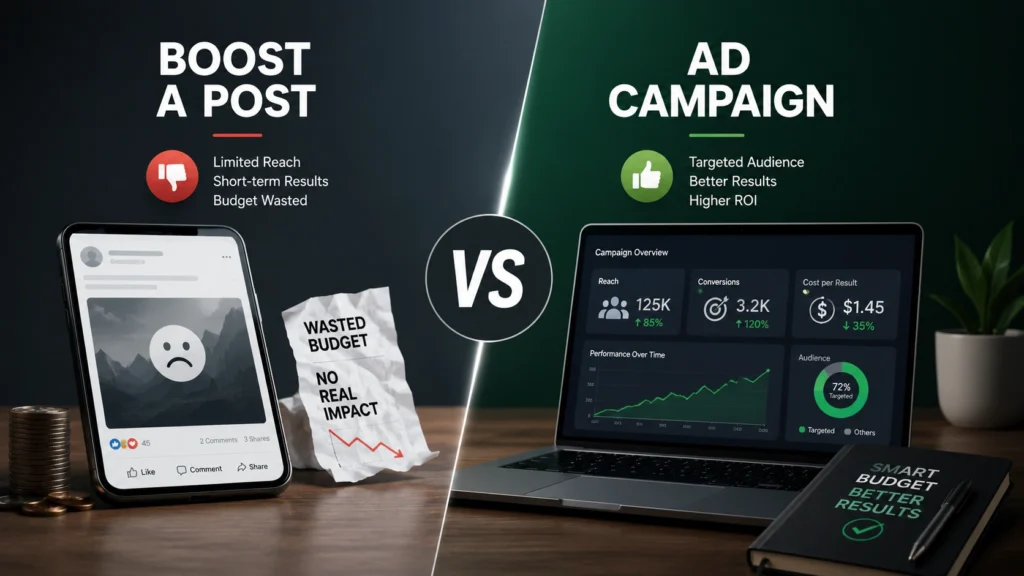
Campaigns let you optimize specifically for the outcome you actually want. If your goal is website traffic, campaigns optimize delivery toward people likely to click through. If your goal is conversions, campaigns optimize toward people likely to complete a purchase.
This targeted optimization is something the boost button simply cannot replicate, regardless of budget. Additionally, campaigns allow effective use of the Meta Pixel, tracking actual website actions. This data then feeds back into future targeting, making each campaign smarter than the last — a clear advantage in the boost a post vs ad campaign comparison.
When Boosting Might Actually Make Sense
Boosting isn’t always the wrong choice. For genuinely simple goals — like quickly increasing visibility on an event post — boosting can work reasonably well.
- Useful for time-sensitive, low-stakes content
- Reasonable when you need quick visibility without strategic optimization
- Helpful when you want more eyes on an already high-performing organic post
This is often where the question of is boosting a post worth it comes up most directly. However, for anything tied to actual business growth, a real campaign almost always delivers stronger, more measurable results.
Cost Comparison Between the Two
Boosting often appears cheaper upfront since minimum budgets are low. Nevertheless, the cost per meaningful result is frequently higher than a properly optimized campaign, since boosting isn’t built to find your most valuable audience efficiently.
Ad campaigns require a slightly steeper learning curve. Still, testing multiple audiences and creatives typically leads to a lower cost per genuine outcome over time. It’s also worth noting that campaigns allow budget reallocation mid-flight, something boosting doesn’t support — another point in favor of campaigns in the boost a post vs ad campaign decision.
The Learning Curve Worth Investing In
Many business owners avoid Ads Manager because it initially looks overwhelming. However, the core skills needed are learnable within a few campaigns, especially starting with one clearly defined objective like traffic or lead generation.
Once comfortable with basic setup, testing different audiences and creatives becomes significantly easier, and results typically justify the time investment.
Common Mistakes Businesses Make
- Boosting every post instead of building an actual strategy
- Assuming engagement automatically means business results
- Never testing different audiences or ad creatives
- Ignoring Ads Manager entirely due to its learning curve
- Judging success purely on likes and comments rather than conversions
- Failing to install tracking pixels, losing valuable data
How to Decide Between the Two
- Need quick, low-stakes visibility? Boosting can work for simple, time-sensitive posts
- Need actual leads or sales? A real campaign is worth the extra setup time
- Testing a new offer? Campaigns allow testing multiple versions simultaneously
- Limited time to learn? Start with boosting, but plan to transition as budget grows
Understanding the difference between boost and campaign ultimately comes down to your specific business goal, which makes this framework a useful starting point.
Transitioning From Boosting to Full Campaigns
If you’ve relied primarily on boosting, transitioning doesn’t need to happen all at once. Start with one campaign, one clear objective, using content similar to what’s performed well organically.
Compare results directly against your typical boosted post performance, focusing on business outcomes rather than engagement numbers. This comparison often makes the value difference immediately clear.
Final Thoughts
The boost a post vs ad campaign debate ultimately comes down to what you’re actually trying to achieve. Boosting offers simplicity and quick visibility. However, it lacks the targeting precision and optimization power that drives real business results.
For genuine growth, investing the extra time to run a proper campaign almost always pays off more than repeatedly boosting posts.
Not sure which approach fits your specific goals? Get in touch with me for a quick strategy review.
Frequently Asked Questions (FAQs)
1. Is boosting a post the same as running an ad campaign?
No. Boosting uses simplified targeting and mainly optimizes for engagement, while campaigns offer advanced targeting and specific objectives like leads or sales.
2. Is boosting a post ever worth it?
Yes, for simple, low-stakes goals like quick visibility. For genuine business results, a full campaign typically performs better.
3. Why do boosted posts get engagement but not sales?
Boosting optimizes primarily for engagement, showing content to people likely to interact with it, not necessarily people likely to purchase.
4. Is running a real ad campaign more expensive than boosting?
Not necessarily. Campaigns often deliver a lower cost per genuine result, like a lead or sale, compared to boosting.
5. Can I test different versions of an ad through boosting?
No. A/B testing is only available through full campaigns in Ads Manager.
6. How long does it take to learn Ads Manager?
Most business owners become comfortable within a few attempts, especially starting with one clear objective.
7. Does the Pixel matter if I’m just boosting posts?
It provides limited value with boosting alone, becoming far more useful once you transition to proper campaigns.
